The remarkable journey of the Reiss family through war-torn Europe.
Sometimes, no matter how carefully we try to avoid danger, history has other plans. That was the case for Henryk and Lucja (Luisa) Reiss, whose incredible story of survival during World War II is now featured in a temporary exhibition at the Galicia Jewish Museum in Krakow, Poland.
In September 1939, as German forces invaded Poland, the young Reiss family fled their hometown of Krakow. With their baby daughter Elzunia in tow, they headed east, believing they would be safer there. But their hopes were soon dashed when, just two weeks later, the Soviet army invaded from the opposite direction.
In search of safety, the family moved to Lviv (then part of Poland, now in Ukraine), a city where Henryk had studied and had contacts. Under Soviet occupation, life was tense but bearable. Both Henryk and Lucja found work in engineering – an area they had both trained in. For Lucja, though, this period brought a heavy burden: she was pressured by the Soviet secret police (NKVD) to report on her co-workers.
Then, in June 1941, everything changed again. Nazi Germany launched a surprise invasion of the Soviet Union. Anti-Jewish violence erupted in Lviv, with both Nazi troops and Ukrainian nationalists carrying out brutal pogroms. A ghetto was quickly established for the city’s Jewish population, and deportations loomed.
The Reiss family realised that the only way to avoid deportation and likely death was to escape their Jewish identity entirely. With great difficulty, they managed to purchase false identity papers for a real Polish couple, Piotr and Stanislawa Daraz. Under these assumed identities, they obtained ‘kennkarte’ – essential documents that allowed Aryan citizens of the General Government to live and work.
Henryk found work as an engineer in one town, while Lucja and Elzunia lived separately in a small town near Warsaw. But living under false names came with constant risk. Lucja was arrested twice and feared her luck might run out. Meanwhile, Henryk’s job was coming to an end. They decided to move once again – this time to Hungary, which at that time had not yet been occupied by the Nazis.
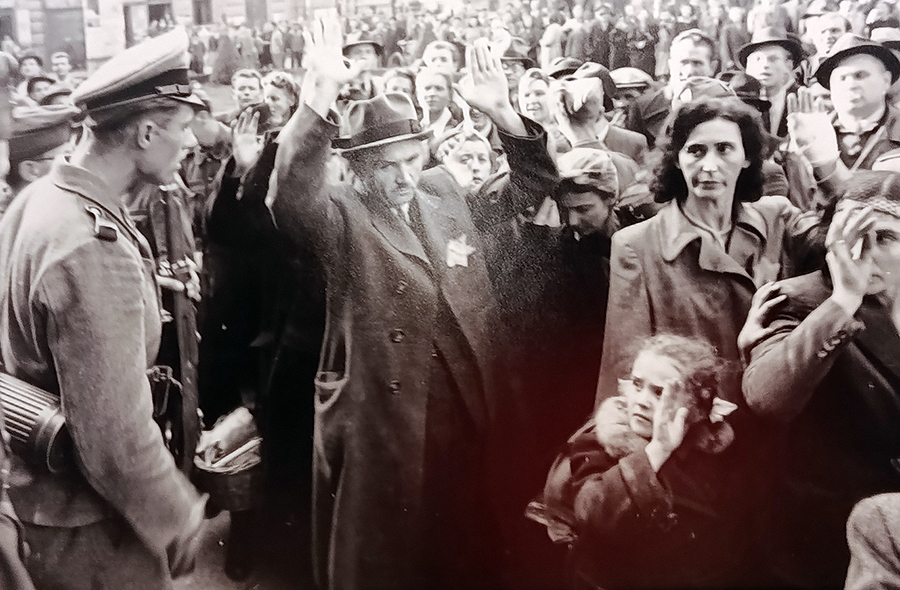
But peace in Hungary was short-lived. In 1944, German forces entered the country, and its Jewish population was swiftly targeted. Mass deportations to Auschwitz began. Despite the growing danger, the Reiss family managed to avoid arrest, continuing to live under their Polish identities in a refugee camp in Budapest.
The war eventually came to an end, and the Reiss family emerged alive. In 1946, they had another daughter, Christine – a name chosen specifically to conceal their Jewish background.
After the horrors they had endured, Henryk and Lucja chose not to return to Poland. Though they had hoped to emigrate to Palestine, this dream was not fulfilled. Instead, their post-war years were spent in a series of cities – Vienna, Ulm, and Paris – before they eventually settled in Australia.
The Reiss family’s story is one of extraordinary resilience, resourcefulness, and courage in the face of overwhelming odds. Their ability to navigate shifting dangers across multiple countries, while keeping their daughter safe and preserving their own lives, is a powerful testament to the will to survive.
Their journey reminds us that history can shift in the blink of an eye, but the human spirit endures – even under the darkest of skies.
The Galicia Jewish Museum – located in Kazimierz, the Jewish district of Kraków, Poland – was established to commemorate the victims of the Holocaust and celebrate the Jewish culture of Polish Galicia. The Museum seeks to challenge the stereotypes and misconceptions often linked to Poland’s Jewish past and to educate both Poles and Jews about their own histories, whilst encouraging them to think about the future.
- For the current edition of the Cape Jewish Chronicle, click here.
- Subscribe to the Cape Jewish Chronicle: R450/year, or R38/month via debit order. Simply email us at subscriptions@ctjc.co.za and click here for payment info.
- The Cape Jewish Chronicle reaches over 6 000 readers monthly across print and digital platforms.
- To book advertising space or discuss a custom package contact Adéle Gradner Mobile: 083 321 5222 | Office: 021 464 6736 | Email advertising@ctjc.co.za