Humble, yet forceful, and with a clear sense of purpose. Hugely successful – but with none of the arrogance so often associated with success. That’s Albie Sachs, a figure of great prominence in our country. It’s a prominence that crosses many fields: law, social activism, politics, the arts, and so on.
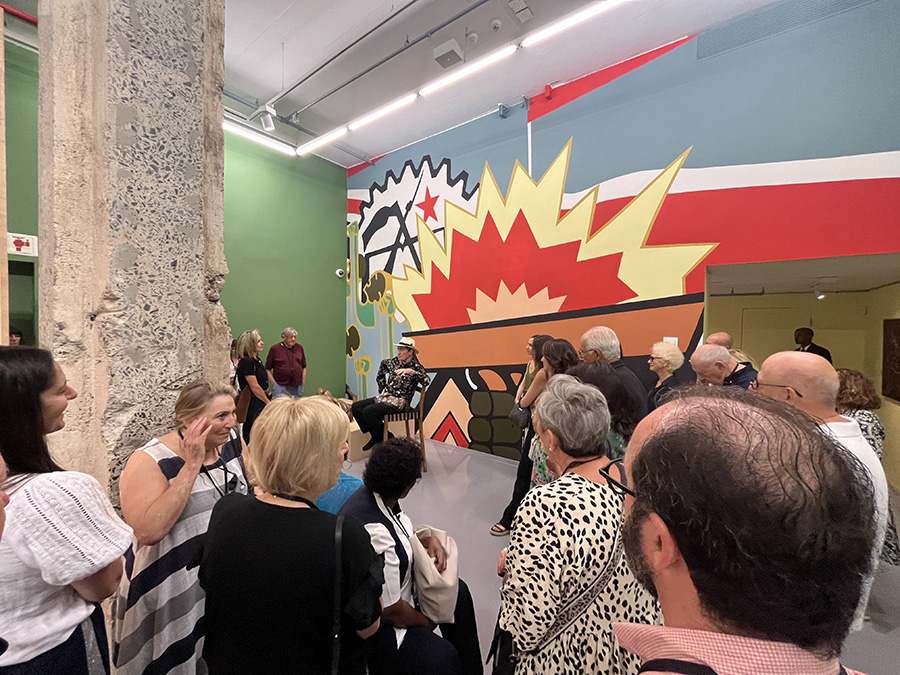
A group of art-lovers recently enjoyed the rare privilege of spending dedicated time with this Former Justice of the Constitutional Court of South Africa, as he conducted a walkabout of the art collection he put together with the Zeitz MOCAA (the Zeitz Museum of Contemporary Art Africa). The event was hosted by SAFIM Art Collaborative, which has organised over 100 art events between Cape Town and Johannesburg since its founding in 2014. The fascinating collection, Spring is Rebellious – The Art & Life of Albie Sachs (which will be on display until 23 August) is a mix of pieces selected by Albie and fellow judges for the Constitutional Court’s collection, Albie’s personal collection, as well as other items on loan from various institutions.
Guiding the group through the works, Albie’s commitment to Africa – his love of the people and of the countries on the continent – becomes clear. This is especially true of Mozambique, the country he spent 14 years in during his life in exile from Apartheid South Africa. Taking up an appointment as a professor of law in Maputo in the years following the country’s independence from its colonial power, Portugal, he helped shape the country into a new free society, unshackling itself from its colonial limitations.
Contrasting with his fierce love of Mozambique is the reality that this is where he almost lost his life, when he was blown up by a bomb planted in his vehicle in Maputo. It cost him an arm and the sight in one eye – but also sparked deep thought about the nature of harm and the potential thirst for vengeance, a topic that is beautifully unpacked in a section of the Zeitz MOCAA called Soft Vengeance.
Inside a curtained-off area called The Hug Room, there is just one small wooden sculpture, accompanied by the sound of Albie’s gentle voice. He explains in the recording of his voice that, after he was so severely injured by the bomb, a colleague promised to take revenge. For Albie, the idea of this type of vengeance was anathema. Instead, he said, “I knew that the best revenge would be to achieve a free, democratic South Africa – and that’s what we’ve done!”
The small wooden sculpture there is a poignant symbol of this message. Sculpted by the Mozambican artist Naftal Langa, Albie acquired it some years before the bombing. Prophetically, its message mirrors his own experience: the sculpture is titled You might have lost your leg my husband, but we have gained our independence. The sculpture depicts, explains the booklet about the exhibition, “a couple…sharing a moment of sorrow and comfort. The stump of the man’s missing leg is unflinchingly rendered.” In the exhibition area, a photograph reflects Albie standing with his back to the camera, looking into a mirror. “His amputated arm appears twice – once in the foreground, and again reflected…”. The chilling parallels are obvious.
Listen to Albie Sachs speaking about the issue of vengeance.
During the walkabout, Albie highlighted the talent of a number of artists. He spoke of Dumile Feni as “the greatest artist I’ve ever known”, whose work is described in the exhibition booklet as “intense and evocative drawings [that] capture the psychological and spiritual trauma of racial oppression”.
Albie drew the group’s attention to the huge photograph of him sitting side by side with Feni in 1976. The photograph “reflects Sachs’ enduring relationships with artists, which helped shape his worldview,” explains the booklet.
The walkabout gave the group a closer look at some pieces selected for discussion by Albie himself, and he shared the stories relating to some of his choices. For instance, the large wooden panels in the last hall were produced by Cecil Skotnes and Hamilton Budaza at Albie’s request when he was setting up the Constitutional Court’s art collection. With very limited funds at hand to purchase works of art, Skotnes agreed to give of his services pro bono, leaving the Court liable only for the cost of the materials.
In addition to the wealth of art and art books on display, the exhibition serves as a valuable record of the uncomfortable – and subsequently miraculous – history of our country. A detailed timeline in one part of the exhibition records Albie’s personal journey, as well as the events happening around him at various times. One item of significant personal interest is the Handspring Puppet Company’s Ubu and the Truth Commission. This large artwork includes a small suitcase: it was given to Sydney Kentridge by Bram Fischer, a reminder of a legal case involving Albie’s father, Solly Sachs, when these two lawyers represented Solly.
There are many other installations and fascinating stories in this exhibition. It’s certainly well worth a visit, and parents should give a thought to taking their children (in particular, teenage and young adult children) to it: it provides a valuable, very human insight into our country’s past. ●
SAFIM Art Collab
SAFIM Art Collaborative is a non-profit organisation with a goal of fostering increased participation in, and support for the arts. SAFIM Art Collab was founded as the South African Friends of the Israel Museum, Jerusalem, and has since expanded their scope significantly to support the local arts scene as a priority too.
Founded and Co-chaired by Marco van Embden, Nina Kovensky and Suzanne Ackerman, the organisation focuses its funding on art education-centred programming, such as internships and fellowships (both locally and at the Israel Museum); tertiary education bursaries at the Ruth Prowse School of Art, Cape Town; an education programme for Ethiopian-Israeli children at the Israel Museum, and more.
The Albie Sachs event formed part of SAFIM Art Collab’s annual membership programme, within which members visit various collections, institutions, art studios and more. The membership programme is a key part of their fundraising approach. To enquire about membership, contact lisa@artcollab.co.za.
The Constitutional Court art collection
The art exhibition draws attention to the significant collection of artworks held by the South African Constitutional Court. The collection was largely put together by Justice Albie Sachs and Justice Yvonne Mokgoro, when they were first appointed to the Court in 1994. Their guiding principle in selecting works for the collection was that the art should reflect the values of the new democracy – things like social justice and human dignity.
Provided with a miniscule budget, the two Judges encouraged artists, patrons of the arts and galleries to donate works, a successful approach that gave the collection a solid start with approximately 200 pieces.


- For the current edition of the Cape Jewish Chronicle, click here.
- Subscribe to the Cape Jewish Chronicle: R450/year, or R38/month via debit order. Simply email us at subscriptions@ctjc.co.za and click here for payment info.
- The Cape Jewish Chronicle reaches over 6 000 readers monthly across print and digital platforms.
- To book advertising space or discuss a custom package contact Adéle Gradner Mobile: 083 321 5222 | Office: 021 464 6736 | Email advertising@ctjc.co.za