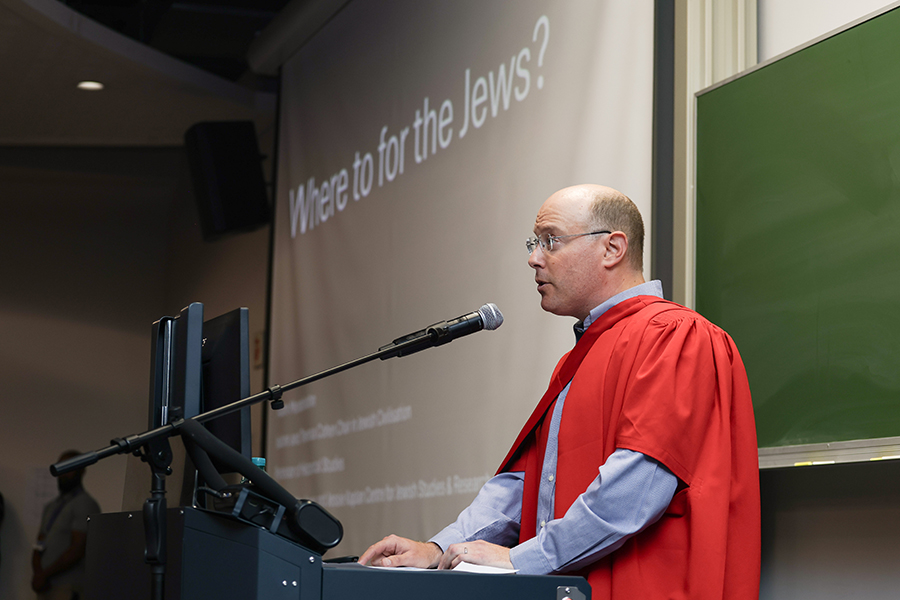
At the end of April, large numbers of people from Cape Town’s Jewish community joined the crowds who filled two venues at the University of Cape Town (UCT) to listen to the Inaugural Lecture presented by Professor Adam Mendelsohn, the Director of the Kaplan Centre for Jewish Studies at UCT.
Providing an insightful look at the current scenario for Jews in South Africa in his talk, Where to for the Jews?, Professor Mendelsohn provided a thoroughly-researched history of antisemitism in the world at large and in South Africa, before looking at the current situation facing Jewish communities, including our own community in Cape Town. A significant focus of the speech was the past relationship between the University of Cape Town and its Jewish students, a relationship that has changed in recent times.
While the talk was both fascinating and entertaining, Professor Mendelsohn’s conclusion left many in his audience feeling both depressed and concerned about the future. As he said, “The future for Jews in South Africa…is a future where Jews are marginalised, maligned, and made unwelcome. I hope that I am wrong.”
The event marked a significant stage in Professor Mendelsohn’s academic career. The Inaugural Lecture is a formal acknowledgement of his promotion to a full Professorship in the UCT Humanities Department, a promotion made in recognition of his scholarship and academic output.
The Cape Jewish Chronicle shares particular elements of the speech made by Professor Mendelsohn at his Inaugural Lecture.
To view the recording of the speech on YouTube, click here.
Why UCT was popular among Jewish people
“In the Russian empire, Jews encountered severe restrictions that limited their ability to move out of the Russian borderlands and into more prosperous cities like St Petersburg, as well as limits on access to universities. The first state-mandated quota – the ‘numerus clausus’ – was introduced by the Russian state in 1887 and set limits on the admission of Jewish students to 10 percent in the Pale of Settlement, 5 percent outside the Pale of Settlement, and 3 percent in Moscow and St. Petersburg.
“Strikingly, UCT did not introduce quotas, despite pressure to do so. Vice Chancellor John Carruthers Beattie insisted in 1928 that, in his words, ‘as long as I and others are here there will be no discrimination against Jews.’ Such sentiment was not a given at the time.
“For Jewish immigrants and their children, public school and then university education promised a degree of social and economic mobility unimaginable in the Russian Empire. These immigrants typically sent their children to public schools so that the second generation was thoroughly South Africanized.
“[T]he South African College, the forerunner of UCT, took its cue from Scotland. In addition to being staffed by Scottish professors…it adopted the openness to Jews and other religious dissenters typical of Scottish universities. As a result, the South African College, and then UCT, became a magnet for Jewish immigrants and their children.
“Here was the transformative power of the university. Within a single generation, the children of immigrants achieved prosperity and status unimaginable to their immigrant parents, and entirely inaccessible in the Pale of Settlement.
“This was a place that transformed their families’ trajectories. This was a place where the application of liberal values – as exemplified by the broad-minded John Carruthers Beattie – offered inclusion and acceptance when this was not a given. Hence the Jewish faith in liberalism as a protector of minority rights. This was a place where ability and talent counted more than social origins. This was a place where an antisemitic slur – Ikey – was ultimately transvalued into a badge of pride.
“Thanks to this history, Jews have long felt entirely at home at UCT. “[Y]ou can begin to understand the deep sense of attachment and loyalty felt by many Jews toward UCT, as well as the particular role of the university as a social and economic escalator.
“Given this sense of attachment, Jews constituted a significant minority amongst students for more than a century, and particularly so in the medical faculty. Between 1922 and 1929, for example, 29 percent of all medical graduates at UCT were Jewish.
“A final example of what Howard Phillips describes as a ‘congenial environment’ for Jews is telling. In 1967, during the Six Day War, UCT gave a leave of absence to 77 Jewish students who wished to volunteer in Israel.”
Where does the term ‘Ikeys’ come from?
“It is no accident that UCT’s nickname – the Ikeys – comes from this same period. It originated in 1919, at the intervarsity rugby match against Stellenbosch University, when students from the latter institution sang songs taunting UCT. One of their grounds for doing so was the large number of Jewish students at the University of Cape Town. At the time, the registrar estimated that nearly a quarter of all students at UCT were Jewish. Ikey was a shortening of the name Isaac, and was used as a slur to refer to Jews.
“Today it is shorn of its original meaning, and now worn as a badge of pride, but is a vestige of this era when it meant something that UCT attracted and accepted Jewish students.”
Snippets from Professor Adam Mendelsohn’s speech:
Here follows further extracts from Professor Adam Mendelsohn’s Inaugural Lecture:
“Phenomena which carry unfortunate echoes of the past – widely shared advice not to wear identifiable Jewish symbols when walking in parts of Paris and London, threats and violence against Jewish institutions, ideological purity tests applied only to Jews – have become part of a new normal.”
“[A] paradox: The number of Jews in the world today is smaller than the total population of Gauteng, still well short of the historic peak of 16.6 million Jews in 1939, before the Holocaust. Today Jews make up 0.2 percent of the world’s population, and an even smaller share – 0.08 percent – of South Africa’s. The entire South African Jewish population would not even fill the Cape Town stadium. And yet in South Africa and globally, ‘the Jew’ occupies a prominence in the public and popular imagination that belies their numerical inconsequence.”
“[O]ver the last two years, Jewish institutions in the diaspora have been attacked – often rhetorically, sometimes physically – because Jews are associated in the public mind with Israel. The ugly spat between Roedean and King David High School in Johannesburg was a local example.”
“For those on the left, the Jew was easily imagined as the arch capitalist exploiter. For those on the right, the Jew was easily imagined as the socialist revolutionary undermining the foundations of society.”
“The Kaplan Centre has tracked…numbers for the last four decades. At its zenith in 1970, the Jewish community numbered 118,200. In 2001, we estimate that there were at least 69,000 Jews in South Africa. Today it is close to 50,000. This is largely the product of emigration. The effects of emigration are now accentuated by aging. The median age of Cape Town’s Jewish population is 45 as compared with the national average for the broader South African population of approximately 28.”
“[T]he…[Jewish]…population is concentrated in Johannesburg and Cape Town. As a result, fewer South Africans will interact with Jews on the street, in schools, in the workplace, and in social settings, rendering them less visible and less familiar. The result is that most people in South Africa have never knowingly met a Jew.
That absence matters.”
“Not for decades has the place of Jews in society been so uncertain. Even though they are full citizens and their rights protected by the Constitution, the figure of ‘the Jew’ has surfaced in South African public life. This manifests as crass prejudice, in an obsession with Jews in the media, in the differentiation between ‘good’ Jews and ‘bad’ Jews among public intellectuals and academics, in the targeting of Jewish-owned businesses and performers for boycotts as if they are an extension of the Israeli state, and in the dismissal of the concerns expressed
by Jews.”
- For the current edition of the Cape Jewish Chronicle, click here.
- Subscribe to the Cape Jewish Chronicle: R450/year, or R38/month via debit order. Simply email us at subscriptions@ctjc.co.za and click here for payment info.
- The Cape Jewish Chronicle reaches over 6 000 readers monthly across print and digital platforms.
- To book advertising space or discuss a custom package contact Adéle Gradner Mobile: 083 321 5222 | Office: 021 464 6736 | Email advertising@ctjc.co.za