By JEANINE HACK
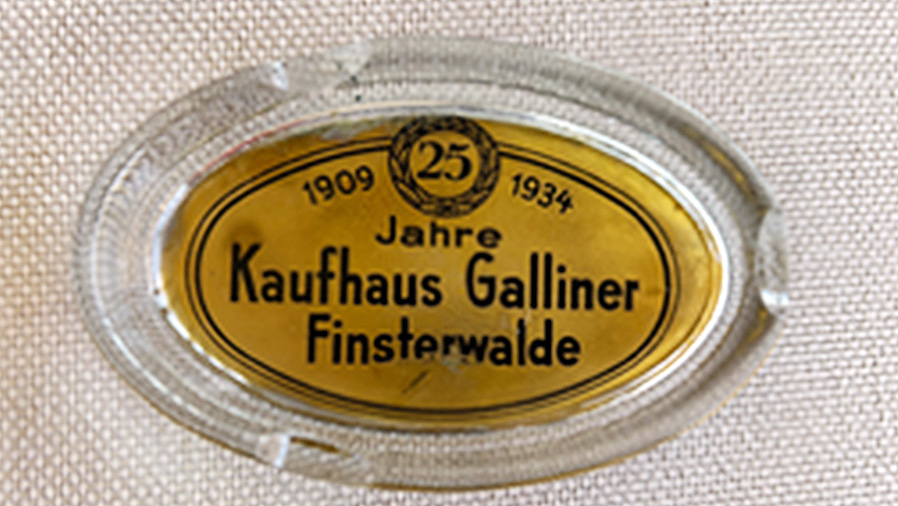
In 1909 my great-grandparents, Emil and Martha Galliner, opened Kaufhaus Galliner, a department store in Finsterwalde, Germany. Twenty-five years later, in 1934, they marked the milestone by presenting commemorative ashtrays to valued customers.
No one could have imagined that one of those small glass ashtrays would survive the Nazi era and, 92 years later, find its way back into the hands of their descendants in Cape Town.
In November 2025, I received an unexpected email from Babette Weber, head of the Museum Association in Doberlug-Kirchhain, Germany. She wrote that additional Stolpersteine (‘stumbling stones’) had been laid in nearby Finsterwalde, commemorating victims of Nazi persecution. Among those honoured were Leo Henesch, who survived Kristallnacht and eventually escaped to the United States; Max Schmidt, who was executed for telling a political joke; and Paul Liehr, who died in a concentration camp after being imprisoned for his Communist beliefs and for secretly listening to Radio Moscow.
At the Stolpersteine ceremony, a descendant of Paul Liehr, Ina Liehr from Hamburg, asked whether anyone was in contact with descendants of the Galliner family. She had inherited what she believed was an advertising ashtray from Kaufhaus Galliner and felt it belonged with the Galliner family.
When Babette contacted me with the news, I was astonished. Because South Africa’s postal service is unreliable, Ina kindly agreed to send the parcel to my daughter in France. During a recent visit, I brought the ashtray safely home to Cape Town.
The ashtray had taken a very different route from my great-grandparents’ own extraordinary journey, but at last it had reached its rightful home.
Ina later explained how it had come into her family’s possession. Her parents had lived in a house in Finsterwalde that had belonged to the family for two generations. When the house was eventually sold, the ashtray was one of the very few possessions she chose to keep and took with her to Hamburg.
Only after attending the Stolpersteine ceremony for her great-grandfather did she learn the story of Emil and Martha Galliner and the persecution that forced them to flee Germany. Returning home, she looked at the ashtray with new eyes and realised it was not simply an old souvenir, but an important family memory that should be returned.
Inside the parcel was the commemorative ashtray together with a beautifully handwritten postcard in German that moved me deeply. It read:
“Good day Mrs Hack. Here is the small ashtray in your hands. I am delighted to deliver it to you. My parents lived in a house in Finsterwalde that had belonged to our family for two generations, and somehow this ashtray remained there, probably because Kaufhaus Galliner had once been such an important business in the town. When the house was sold, I took the ashtray to Hamburg. It was one of the very few things I kept. At the Stolpersteine ceremony in honour of my great-grandfather, I heard the story of your great-grandparents. Once back in Hamburg, I saw the ashtray through new eyes. It gives me great pleasure to return this item of memory to your family. With kind regards, Ina Liehr.”
Her postcard resonated particularly strongly with me because my book, Epitaph Of No Words / Epitaph Ohne Worte, is itself built around postcards. They tell the remarkable story of Emil and Martha Galliner’s 19-year odyssey as displaced persons after Kristallnacht.
On 10 June 1941 they escaped Nazi Germany by train to Moscow, travelled across the Soviet Union on the Trans-Siberian Railway, continued through Manchuria to Dalian – a city in China – and crossed the China Sea to Shanghai, spending the war years in the Shanghai Ghetto. In 1947, they were evacuated by the American Jewish Joint Distribution Committee (JDC) to the United States aboard the troop transport SS Marine Adder. After struggling to establish themselves in Chicago, they eventually travelled via Britain to South West Africa (now Namibia), where they were reunited with children and grandchildren they had not seen for sixteen years. Their long journey finally ended in Johannesburg.
The little ashtray made a different journey, but one that was no less remarkable.
For nine decades it survived in the home of a family whose own ancestors had suffered Nazi persecution. It remained quietly preserved until a chance encounter at a Stolpersteine ceremony connected two families whose histories had intersected in Finsterwalde almost a century earlier.
Sometimes history returns not through official archives or museums, but through the kindness of strangers.
Holding the ashtray in my hands, I realised that it had survived where so much else had been lost. This small commemorative ashtray is now far more than a piece of advertising. For more than nine decades it had quietly endured, passing from one family to another until history, memory and human kindness combined to bring it home. It is no longer simply a commemorative gift from a department store. It is a tangible link to a lost family business, to lives interrupted, to families connected across generations, to a vanished Jewish community, and to the enduring generosity of people who believe that memory should find its way home.