South Africans have far more power to bring about change than they may realise – but only if they are prepared to use it.
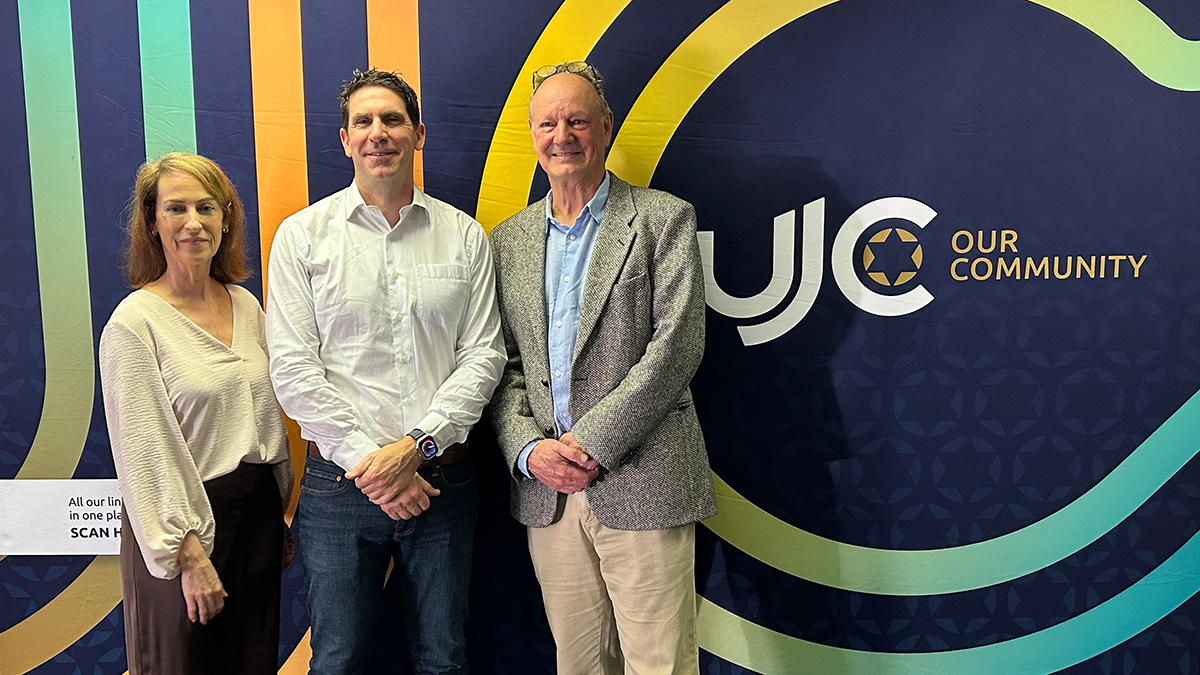
That was the central message from Wayne Duvenage, chief executive of the Organisation Undoing Tax Abuse (OUTA), when he addressed a recent United Jewish Campaign (UJC) Business Breakfast in Cape Town. Drawing on more than a decade of civil activism, Duvenage spoke about corruption, accountability and the role ordinary citizens and businesses can play in defending democracy.
For Duvenage, it is a role he never expected to occupy. Before becoming one of South Africa’s most prominent civil activists, he spent decades in the travel and tourism industry, including five years as chief executive of Avis South Africa.
“I certainly didn’t have civil activism on my CV when I left Avis,” he said. “It happened, and it happened for a reason.”
That reason was the controversial Gauteng e-tolling system. OUTA was established in 2012 as the Opposition to Urban Tolling Alliance to challenge the scheme, which Duvenage and his colleagues believed was fundamentally flawed.
Rather than immediately resorting to litigation, the organisation researched the issue and spent more than a year attempting to persuade government to reconsider. When that failed, it turned to the courts and, critically, to the public.
“It was about the principle in the scheme,” Duvenage said. “It was about doing what is in the best interest of society.”
The e-toll fight became a powerful lesson in the influence of organised civil society. It also taught OUTA the importance of what Duvenage calls “narrative economics” – owning the story, communicating it clearly and ensuring that an issue remains in the public eye.
The approach taken in the e-tolls example was to galvanise public support for non-compliance. As Duvenage explained, “The International benchmark for successful e-tolling is 90% compliance. We encouraged members of the public not to comply because we believed that the scheme was fundamentally flawed. Ultimately, non-compliance reached such a high level that the scheme was not sustainable.”
E-tolls were eventually switched off in 2024, but OUTA had by then evolved into a much broader organisation. Today it tackles corruption and maladministration across areas including public procurement, energy, transport, higher education and government oversight. With over 30 staff members, the organisation is currently dealing with more than 350 projects.
Duvenage cited the proposed Karpowership deal as another example of sustained civic intervention. OUTA challenged plans to procure electricity from floating gas-powered ships, believing that there was a risk that, should load-shedding come to an end, the country would be tied into the Karpowership contract for many years ahead. The opposition tactics included legal and environmental processes, and ultimately OUTA succeeded in challenging electricity generation licences for the three proposed projects.
The organisation’s work relies heavily on whistleblowers, who provide information about alleged wrongdoing. OUTA helps them understand how to submit evidence while minimising unnecessary exposure.
But Duvenage stressed that defending democracy cannot be left solely to organisations such as OUTA. Business, too, has a role to play.
“Business doesn’t want to challenge government,” he said, arguing that companies cannot separate their own prospects from the health of the institutions and society in which they operate.
“If we don’t defend the democracy against this corruption, then there is no country to do business in.”
Duvenage clearly believes that the future cannot lie with an ANC-dominated government. “Liberation politics was important in 1994,” he explained, “but now we need politics that looks at the future of the country.”
With local government elections approaching, Duvenage also emphasised the power of the vote – while cautioning that active citizenship cannot begin and end at the ballot box.
“Active citizenry works every single day,” he said.
Citizens do not have to become full-time activists to make a difference. They can ask questions, vote, support civil society organisations, provide information, challenge questionable decisions through lawful channels, and remain engaged with what is happening around them.
Despite the scale of South Africa’s challenges, Duvenage’s message was ultimately optimistic. He pointed to the country’s resources, tourism potential and functioning institutions as evidence that its problems are not insurmountable.
“I’m excited about South Africa,” he said. “We have amazing potential.”
It was a message that resonated strongly with the ethos of the UJC: that strong communities and societies depend not on spectators, but on people willing to participate, contribute and take responsibility.
For more information, visit https://www.outa.co.za/
- For the current edition of the Cape Jewish Chronicle, click here.
- Subscribe to the Cape Jewish Chronicle: R450/year, or R38/month via debit order. Simply email us at subscriptions@ctjc.co.za and click here for payment info.
- The Cape Jewish Chronicle reaches over 6 000 readers monthly across print and digital platforms.
- To book advertising space or discuss a custom package contact Adéle Gradner Mobile: 083 321 5222 | Office: 021 464 6736 | Email advertising@ctjc.co.za