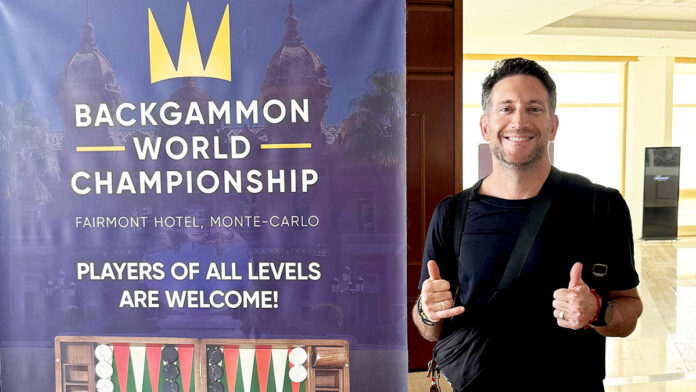
When the world’s number one player asks for a photo with you, it’s a moment you never forget. That’s exactly what happened to Sea Point-born Doron Claxton, fresh from his first-ever Backgammon World Championships – and his astonishing runner-up finish in Monte Carlo this August.
A self-described “social, non-professional backgammon enthusiast,” Doron stunned the global backgammon elite by reaching the finals – something no newcomer had managed to win in 35 years.
“Playing against the Giants of the Game had always been a dream,” Doron says. “But actually being there, competing with them, was beyond anything I’d imagined. Honestly, I wasn’t even meant to go – I invited myself to the tournament after a casual conversation during a chouette game.” (Chouette is a type backgammon game.)
“It’s an intellectually thrilling game,” he says. “It’s about skill, yes, but also luck. One roll of the dice can turn everything on its head – that’s the pure magic of the game.”
In the space of one unforgettable week, Doron battled through match after gruelling match – most lasting over three hours – against some of the best players in the world. He earned a standing ovation as he stepped up to receive his silver medal.
“Play backgammon for the fun, the challenge, and the friendships it brings,” he says.
His love for the game began over 30 years ago when his aunt in Israel taught him to play. Back at Herzlia, most of his breaktimes were spent locked in fierce battles over the board.
Now, with invitations to compete internationally already on the table, Doron has his sights set on returning to Monte Carlo next year – and inspiring a new wave of players around the world. He’s passionate about growing the game not only in South Africa but globally, and getting more young people into the fold.
Alongside fellow Cape Town enthusiast Nick Groll, Doron helps run the South African Backgammon Association, which now connects players both locally and internationally through online and in-person events.
Interested in playing backgammon? Find Cape Town Backgammon on Instagram and Facebook, or connect with Nick at nick@sabga.co.za / WhatsApp +27 71 121 7022
For the current edition of the Cape Jewish Chronicle, click here.
Jim and Irene Goodacre in London in the late 1970s
Written by DOMINIQUE HERMAN
“I don’t think I am exaggerating when I say that he was more than 30 years ahead of his time in his understanding of primary school children and how they learn,” said Shirley Kaminer at the memorial service for Jim Goodacre, the beloved former principal of Herzlia Constantia Primary. Kaminer was Jim’s deputy.
Tony Steward, a teacher at Wynberg Boys’ Junior School who was a pupil when Goodacre was its deputy headmaster, described Jim bringing a video camera into the classroom before television arrived in South Africa. “It was just one of the ways he was so innovative in his teaching methods,” he said. Jim wrote the lyrics for the school song for Wynberg Boys’ Junior and High – described by Steward as “a massively unifying force”. It’s been sung weekly for 41 years.
After his sudden resignation from Wynberg Boys, Jim looked for a position in a private school. “I knew of Herzlia, but I didn’t even consider it because, I thought, ‘It’s a Jewish school; they’re not going to want people that are not Jewish’,” he said in an interview in 2020 ahead of the closure of Herzlia Constantia. Years later, he discovered that parents at the school had petitioned the UHS to appoint him to the role when Mike Pincus left as principal.
He attributed his Herzlia school career to “a chance meeting that just completely changes your life”. That chance meeting occurred at an inter-school English conference in KZN. Shortly after he resigned from Wynberg, Herzlia Weizmann’s then principal, Stan Lifschitz, contacted him to set up an exploratory chat. “It was like talking to somebody exactly on the same wavelength,” Jim said.
In 1979, Pincus started as principal of Herzlia Constantia on the same day Jim began as deputy. Jim became principal in 1984, “thereby achieving his ambition of heading his own school”, said his son, Peter Goodacre, at the memorial. “Those were 19 extremely happy years,” Peter added.
“He was the most progressive educator that we have come across,” Kaminer said. “He not only encouraged creativity in the children but also in the teachers, and we all became better educators because of him.” Irene Berman, the mother of three Herzlia alumni (one of whom, Benjamin, is the deputy principal of Weizmann), said that Jim “not only educated our children, but also us parents”.
“I really believe,” Jim said in 2020, “and this is really the heart of my, I’ll call it, philosophy of primary school education, that children who are happy and laughing at school do very much better than those children who don’t like coming to school because it’s a miserable place.”
James George Goodacre was born on June 7, 1933, in England. He died in Cape Town on June 11, 2025.
For the current edition of the Cape Jewish Chronicle, click here.
Daniel Bloch with Barry Mason who cleans the Uniondale cemetery
Earlier this month, our Executive Director, Daniel Bloch, embarked on a trip to visit the Jewish communities of George, Plettenberg Bay, and Oudtshoorn. These visits are part of the Cape SAJBD’s commitment to ensuring no Jewish community in our province – no matter how small – is forgotten.
In each town, Daniel met with community members, offering updates on current local and global issues affecting Jews, including the rise in antisemitism, political developments, and Israel-Diaspora relations. There were many questions, deep conversations, and moments of connection. Daniel was warmly welcomed and took part in local religious life, davening on Shabbos in Plett and leading Maariv in Oudtshoorn on Sunday night.
Oudtshoorn: From Jerusalem of the south to a small but proud community
Once known as the ‘Jerusalem of South Africa’, Oudtshoorn was home to over 500 Jewish families in the early 1900s. Today, just 10 families remain, holding tightly to their Jewish traditions and continuing to maintain both the shul and the cemetery.
This cemetery is the second-largest Jewish cemetery in South Africa (after Pinelands). However, it has faced repeated vandalism in recent years. After spending R70 000 on a security system that proved ineffective, the community has now made the painful decision to flatten the remaining gravestones to prevent further desecration.
To complete this project with dignity, the Oudtshoorn community urgently needs to raise R170 000.
Oudtshoorn Needs Your Help So many Jewish families in South Africa trace their roots to Oudtshoorn. Many have loved ones buried in its cemetery. We now turn to the wider community – those who carry the legacy of Oudtshoorn in their family history – to ask for support.
The support of members of our community with a connection to Oudtshoorn is desperately needed to complete this project. Even if you have no connection but would still like to support, this would be greatly appreciated. Please email SAJBD2@ctjc.co.za for more information.
Maintaining Jewish memory across the Western Cape The Cape SAJBD works to maintain Jewish cemeteries across the region – from Caledon and Montagu to Robertson, Worcester, Uniondale, and others. In towns like Riversdale, Ladismith, and Piketberg, we partner with municipalities to ensure these sacred sites are regularly cleaned and respected.
Our cemeteries are not just gravesites. They are monuments to Jewish continuity – to the lives, values, and histories of those who came before us.
During his trip, Daniel met with the incredible people who maintain our cemeteries and look after some of our old deconsecrated shuls.
Barry Mason and the Lions Club in Uniondale look after both the cemetery and the old shul; the Hessequa Municipality maintains the Riversdale Jewish cemetery, and the town is home to the Julius Gordon (Africana) Museum with its own Jewish museum; in Ladismith, the Municipality ensures the small Jewish cemetery is cleaned and kept in pristine condition; Mannie Koopman ensures that the Caledon Jewish cemetery is well looked after; Isadore Olivier and his team do an immaculate job of maintaining the Worcester cemetery; and, in Robertson and Montagu, we have the extremely capable Rentia Anger doing an incredible job.
Our thanks go to all of them for their support.
What’s next?
In the coming weeks, we will be visiting even more of our country communities, including Piketberg, Paarl, Ceres, Stellenbosch, Strand, and Hermanus, to strengthen our relationships and listen to the needs of every corner of our province.
For more information or to contribute to the maintenance of our cemeteries, please contact the Cape SAJBD office via email: Sajbd2@ctjc.co.za
Oudtshoorn Jewish cemeteryMontagu Jewish cemeteryRobertson Jewish cemeteryPlettenberg Bay Shul – still going strong Worcester Jewish cemetery
Image credit: The Robert Henry Freedman Collection, Cape Town Holocaust & Genocide Centre Archive.
PROFESSOR PHILIP LANZKOWSKY
The Cape Jewish Chronicle has brought you a series of articles that reflect the memories of Professor Philip Lanzkowsky of Jewish life in Cape Town during the 1930s and 1940s. In this edition – the last in the series – Philip recalls what it felt like being aware that one’s Jewish brethren were facing huge suffering in Europe, but being unable to do much to assist them.
I often think back to March 1939, when my father’s cousin, Taube, arrived in Cape Town from Poland. She was young, beautiful, clever, and full of life.
She came only on a visitor’s visa, which meant she was supposed to return to Poland in September – just as the world descended into war.
In those few short months she met and married Max Israel, a naturalised South African. That marriage saved her life. She never had to return to Poland and the fate that awaited so many of our family there. I have always thought of Taube as the living embodiment of the verse from the book of Zechariah: “Is this not a brand plucked from the fire?”
As a child in Cape Town, I remember the war not through bombs and destruction, but through conversations around our kitchen table. My parents worried constantly about the family in Poland. My father sent money to them in September 1939, but the Red Cross returned it marked ‘Undeliverable – the addressee in enemy territory’. We imagined they were hungry, cold, and suffering. What we did not yet understand was the full horror of what they were really enduring.
Most families had maps of Europe pinned up on their walls, and we children marked the relentless advance of the German army with pins. News came to us through the crackling of the wireless or the newspaper. Cape Town itself felt only the faintest echoes of war – small food rationing, windows covered with blackout shades, cars with their headlights painted black. At school, we had practice drills, and volunteers in the civil defence corps were trained in basic first aid and how to put out fires with the most primitive equipment.
The strongest reminders of the war were the people. Men in uniform became a familiar sight on the streets of Cape Town, and even in shul on Shabbat. Many of my cousins enlisted in the South African army – some fighting in North Africa against the Germans and Italians. My female cousins also volunteered, driving lorries or working in clerical posts. When Australian troopships docked in Cape Town on their way to Europe, Jewish soldiers were welcomed into our homes, especially over Shabbat and the festivals.
I have always felt a deep pride that around 10 percent of South African Jews – approximately 10 000 men and women – volunteered for service.
One of my clearest memories is of June 1940, when France fell to Germany. The despair in Cape Town was overwhelming, as though there was no hope left. I remember a special service at the Great Synagogue. Chief Rabbi Professor Israel Abrahams spoke with great passion, and when the buglers played ‘Taps’ – usually reserved for funerals – it felt as though the whole community was in mourning.
In the period after the War had ended, people exhibited the stress of wondering whether their relatives had survived. I remember the depressing comments that, “If anybody had survived, we would have heard from them.” This moment is seared in my brain.
We were far from the battlefields, but the war shaped us deeply. We lived with fear for our loved ones, pride in those who served, and the haunting knowledge that, while we were safe, our people in Europe were not. Those memories have never left me.
Read previously published Cape Jewish Chronicle articles from Philip:
Share your memories of the War years with other readers.
Perhaps you remember something yourself or you heard about things from a parent or a grandparent. We’d be interested to know, so please send your stories to editor@ctjc.co.za.
EDITOR’S NOTE: My mother recalled regularly going somewhere on the Foreshore with her mother in the months after the end of the War to search through the Red Cross lists for news of family members. They did not, unfortunately, find any such information. On the other hand, my father, a survivor from Lithuania, was identified on such a list by an American family member who had joined the US Army in Europe to fight against the Nazis.
Image credit: The Robert Henry Freedman Collection, Cape Town Holocaust & Genocide Centre Archive.
For the current edition of the Cape Jewish Chronicle, click here.
Dear Brothers, Sisters, Allies, Friends – even those who do not fit into any of these categories. By the time you read this, many days will have passed since I woke early, left my kibbutz Tzora, and joined thousands of Israelis on the streets with a simple message: “Enough!”
How do I share our situation with those far away? I know you care – whether or not you agree with me on what must be done – and that care means so much.
When I sit down to write, I sometimes wonder what more there is to say. My words can never be filled with the same evil we endured on October 7th.
So, today, 17 August, as we try to find a way forward through these impossible times, and remembering that you will be reading these words, hopefully, as you prepare to welcome in another year, on the eve of Rosh Hashana, I will tell you the story of the group I just guided in Israel, the first synagogue group I have guided here since October 7th. Rabbi Jodi Sieff, a great rabbinical model, brought a small group of congregants to be with us, to learn, to think deeply and to experience in a profound, emotional way, what has happened to us since October 7th. Who we have become; what it means to be an Israeli in 2025. And I am going to say this here in the most categorical way possible: the only way to understand who we are and what it means to be an Israeli in 2025, is to come here.
Remember when a trip to Israel included some time in Jerusalem: the Old City, Machaneh Yehudah, Yad Vashem, Mount Herzl, Mea She’arim (a wonderful, uplifting Shabbat Experience), Masada, the Dead Sea and Ein Gedi, hiking in the Upper Galilee, Tzfat and its beautiful synagogues, the view from Mt Bental into Syria, a wine tasting up north, and finally Tel Aviv – the Carmel Market, the art fair on Nahalat Binyamin, the beach, the Tel Aviv Museum of Art? August in Israel was filled with fun, sun, food, wine, history, a feeling of wonder at the miracle we created after the terrible disaster which befell our People in Europe.
The visit this past week and a half began on Motzei Tisha B’Av with Kinnot, overlooking the Old City and reading that extraordinary line from Breshit, “Lay not thy Hand on the Lad” (an Angel speaking to Abraham as he prepares to sacrifice Isaac); continued to only one day in Jerusalem with a visit to the Old City – but a visit in which we asked the question, “Do we see everything differently today in Jerusalem after October 7th? Is the Kotel the same Kotel? Are the Southern Steps the same Southern Steps? Is the City of David the same City of David?” And then a quick visit to Mt Herzl, the military cemetery, with all the fresh graves. Packing food for the vulnerable as we felt a need to give, and ending the day listening to young Israeli soldiers from my kibbutz, who talked about how guilty they feel with hostages still in Gaza. (They feel guilty? After 300 days of reserve duty! What should we feel?)
One day up north near the northern border. working in the fields of Moshav Abirim and listening to Shula from Moshav Shtula. who has not lived in her home since October 2023. Two days down south in the Gaza Envelope. visiting Sderot, Kibbutz Nir Oz, the Nova Festival site. (Ten days have passed, and I am still reeling from these visits.) Shabbat in Tel Aviv and finally a visit to ANU, the wonderful new museum of the Jewish People. Again, the same question continues to raise its head, to scream at us, “Who are we now after October 7th? Is this the same Jewish People, the same State of Israel?”
I want to end this with a request to all of you to Google Ilay Nachman, and read the story of his life and brave death on October 7th. I promised his mother, Ifat Nachman, after she shared his story and her pain with my group, that I would do everything in my power to make sure that her beloved son would not be forgotten.
Shana Tova and B’Sorot Tovot.
For the current edition of the Cape Jewish Chronicle, click here.