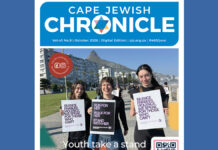
In Jewish communities across the world, leadership is evolving and, in the Western Cape, it is increasingly being shaped by the energy and insight of a new generation of young women. They are stepping forward in bold, thoughtful, and deeply committed ways to shaping the future of their community and country.
From high school hallways to university campuses, youth movements to communal organisations, emerging leaders are claiming their place, and redefining the future of Jewish life. These young leaders are navigating the intersections of identity, tradition, and transformation in a South Africa still reckoning with its complex past. Whether working in education, activism, the arts, or Jewish communal spaces, they are asking tough questions, building inclusive networks, and challenging the status quo, all while staying rooted in Jewish values.
In acknowledging Women’s Day, we spoke to eight inspiring young women about their journeys, their challenges, their hopes for the future, and what it truly means to lead as a young Jewish woman today.
These are the themes that matter most to them.
1. Jewish Identity as Leadership Foundation
Jewish identity is not an incidental factor; it is at the core of their leadership. For Rachel Segal, Chairperson of SAUJS at UCT, Jewish identity became a choice rather than a given when she moved away from her Johannesburg home. “I had to learn to choose Jewish life every day,” she says. That daily decision gave rise to a deeper commitment: representing Jewish students on a campus where being proudly Jewish can feel like a political act. Her leadership flows directly from her identity, and not despite it. Martine Kawalsky Katz, Regional Director of BBYO South Africa sees her role “to challenge the idea that leadership only looks one way. It’s about honouring those who came before me, while also pushing boundaries for those still to come. I’ve learned that my voice is valid, and that I carry generations of resilience with me.”
2. Rising to leadership through need, not ego
Sometimes leadership emerges not from ambition, but necessity. Ruby Kurgan, Chairperson of SAUJS at the University of Stellenbosch, did not set out to lead. But arriving at Stellenbosch and seeing a gap in Jewish life compelled her to act. “There wasn’t a space for Jewish students to connect, so we built one,” she says. What began as a personal frustration became the catalyst for establishing a vibrant and growing Jewish student hub on campus.
3. Youth movements as pillars of continuity
In a world where Jewish identity often competes with the noise of modern life, youth movements remain central to community building. Eden Lipshitz, Chairwoman of Bnei Akiva Cape Town, believes these spaces are where pride and resilience are cultivated. “Bnei Akiva isn’t just a movement: it’s how we pass on fire and purpose to the next generation,” she says. Through song, tradition, and mentorship, youth movements are training tomorrow’s leaders today.
4. Reimagining what leadership looks like
Leadership does not necessarily mean titles or standing behind a podium. Sienna Berridge,Head Student of Herzlia High School, sees leadership in small moments, such as at committee meetings, through peer support, and in honest conversations. “Being a woman, however, comes with its challenges. I have often felt underestimated, but I see that as an opportunity to prove people wrong, not out of defiance, but with grace and confidence. I lead not just with words, but with action and, as a woman, that is a very important thing to do. In both the Jewish community and broader South African society, I see myself as a bridge, especially in my role leading youth and within my school.”
5. Responding to antisemitism with pride, not fear
While many of these women have not faced overt antisemitism, most have navigated subtler, insidious forms. Nina Gordin, a Moishe House resident, notes that much of the antisemitism she encounters comes from ignorance. “That’s why education is key,” she says. Her approach combines pride, visibility, and conversation through helping others understand what it means to be Jewish, and why that identity should never be hidden.
6. Bridging Jewish, South African and Universal Identities
In a country so shaped by its past, these young leaders feel a moral imperative to engage with broader South African issues. As Rachel Segal stated: “I believe it is not only important but essential for the Jewish community to engage meaningfully with broader social justice issues. As Jews, we are no strangers to prejudice, discrimination, and exclusion. We carry with us a deep collective memory of what it means to be targeted, marginalized, and hated simply for who we are. That history gives us not only perspective, but a moral obligation to stand in solidarity with others who have faced and continue to face systemic injustice.”
7. Leading by caring, not just from strategy
For some, leadership is deeply personal. Daniella Beswick of Netzer SA carries the voices of her mother and mentors into every decision. “You don’t lead for recognition, you lead because you care,” she says. Quoting Pirkei Avot, she reminds us: “If I am only for myself, what am I?” This value, care without ego, runs through her work, and through the leadership culture she helps foster in her youth movement.
8. Creating space for diverse Jewish voices
Jewish leadership no longer has a rigid framework for success, which is a principle that Rachael Sara of Temple Israel embodies. As a queer, progressive, interfaith-rooted Jewish leader, she advocates for a broader, more inclusive model of community. “We need spaces where everyone feels like they belong,” she says. Her work focuses on renewing structures that have long felt exclusive, allowing for new expressions of Jewish life to flourish.
These young women are not just responding to issues. They are reframing them. Their leadership is not about titles, but about courage, empathy, and deep commitment to Jewish life in all its complexity. Their collective message is clear: “We are young Jewish women, and are unafraid to lead. We come from a legacy of resistance, justice, and powerful women who refused to be silent. Now it’s our turn to inspire others to challenge inequality, to raise our voices, and to build a future rooted in dignity.“ We are proud to have them as torchbearers in our community. ●
- For the current edition of the Cape Jewish Chronicle, click here.
- Subscribe to the Cape Jewish Chronicle: R450/year, or R38/month via debit order. Simply email us at subscriptions@ctjc.co.za and click here for payment info.
- The Cape Jewish Chronicle reaches over 6 000 readers monthly across print and digital platforms.
- To book advertising space or discuss a custom package contact Adéle Gradner Mobile: 083 321 5222 | Office: 021 464 6736 | Email advertising@ctjc.co.za