For nearly three decades, documentary filmmaker and historian Sean O’Sullivan has been one of the most quietly influential figures preserving and interpreting Jewish history in South Africa, particularly in Cape Town.
By KAREN MILLER
His work has shaped how students, museum visitors, and broader audiences understand local Jewish stories, Holocaust memory, and a range of human rights histories. Yet Sean’s career began far from museum halls and curated archives.
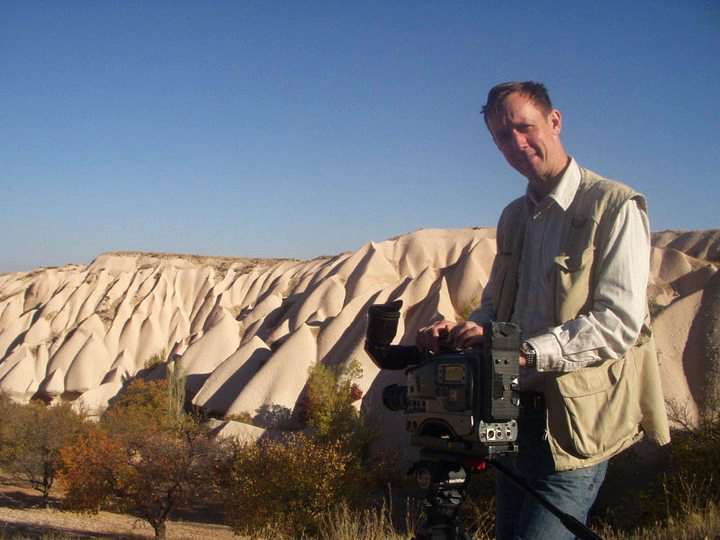
A UCT graduate with an Honours degree in History, Sean’s first major film project took him deep into the forests of Madagascar, documenting illegal logging, an experience that introduced him to investigative fieldwork, complex ethical terrain, and the dangers surrounding environmental crime. He went on to work as a freelance cameraman for major international news networks including CBS, Reuters, and Eurovision, often in places where history was unfolding at high speed and personal risk was part of the landscape.
Over the years, this work took him into situations of real danger. In Zimbabwe, he found himself reporting amidst the wave of politically charged farm killings. In South Africa, he later documented the aftermath of the Marikana tragedy. These formative experiences shaped his sensitivity to injustice, memory, and the responsibility of bearing witness, qualities that would prove critical when he entered the world of historical documentary filmmaking.
Between 2006 and 2016 he worked with the University of Oxford, directing and shooting films for the Oxford Martin School and other clients and participating in research expeditions to the Aral Sea, Southeast Asia, the Amazon Basin, Kazakhstan, Russia, and Greenland. He also spent the summer of 2010 as cinematographer in Antarctica, filming on Palmer Base and across the Bellingshausen and Weddell Seas
This global experience enriched his historical sensibility and sharpened his ability to situate local stories within worldwide patterns of migration, conflict, and identity.
O’Sullivan’s first engagement with South African Jewish history came through a film on Mendel Kaplan, tracing Kaplan’s Lithuanian roots and South African legacy. This project opened the door to more substantial work, beginning with his long association with the USC Shoah Foundation. Starting in 1995, he filmed South African Holocaust survivors, a commission that continues to this day. (The latest was on Hélène Joffe shown at the Cape Town Holocaust & Genocide Centre (CTHGC) in November last year.) That work requires meticulous attention to detail: testimonies are recorded, preserved, and archived for research and education purposes, forming a vital historical record for future generations.
Through the Shoah Foundation, he was introduced to Myra Osrin and soon became centrally involved in documenting survivors at the CTHGC. Over the past 25 years he has created approximately thirty films for the South African Holocaust and Genocide Foundation, many now embedded in the high school history curriculum and presented across all three Holocaust Centres in Cape Town, Johannesburg, and Durban. Sean’s careful interviewing and documentation, alongside that of other filmmakers involved in the Foundation’s projects, ensures their voices endure long after they can no longer speak in person.
His work with the South African Jewish Museum has been equally significant. For the Museum he has produced films exploring South African Jewish memory and migration, including From Things Lost, a project created with historian Dr Shirli Gilbert, and Another Time, Another Place: The Jews of District Six. He has also recently completed films on the Irma Stern Museum and is currently developing a documentary on Helen Suzman, the anti-apartheid parliamentarian whose moral clarity made her one of the most recognisable advocates for justice in South Africa.
Sean’s interests, as both historian and filmmaker, are wide-ranging. He is drawn to the intersections between people, ideas, and moral choices. His methodology reflects this: he enjoys integrating evidence from multiple sources, conducting forensic analysis of historical materials, and searching through archives to reconstruct stories with precision and care.
In recent years, he has also raised concerns shared by many historians and documentarians: the rise of AI-driven manipulation, where the words of interviewees can be altered or fabricated. In his field, where authenticity is the foundation of testimony, the dangers of a ‘post-truth age’ are particularly acute. O’Sullivan’s commitment to careful methodology stands in direct opposition to these risks, asserting the importance of verifiable human stories in an era of synthetic information.
From Madagascar’s forests to Antarctica’s ice fields, to Cape Town’s museums, Sean O’Sullivan has spent his career capturing the fragile, essential threads of human history. For South Africa’s Jewish community, his work has preserved stories that might otherwise have been lost; and in doing so, he has strengthened the collective memory on which our future depends.
- For the current edition of the Cape Jewish Chronicle, click here.
- Subscribe to the Cape Jewish Chronicle: R450/year, or R38/month via debit order. Simply email us at subscriptions@ctjc.co.za and click here for payment info.
- The Cape Jewish Chronicle reaches over 6 000 readers monthly across print and digital platforms.
- To book advertising space or discuss a custom package contact Adéle Gradner Mobile: 083 321 5222 | Office: 021 464 6736 | Email advertising@ctjc.co.za