In 1950, South Africa stepped onto one of the world’s most prestigious cultural stages – the Venice Biennale. It was a moment that might have signalled confidence and cohesion. Instead, it revealed a country deeply divided about art, identity, and its place in the modern world.
South Africa’s participation did not emerge from a clear national strategy. Rather, it was the result of a confluence of ambition, improvisation, and pressure from artists eager to engage with international modernism. Cape Town sculptor Lippy Lipshitz was one of these artists.
The road to Venice began in 1949, when a group of South African artists – including Lipshitz, Irma Stern, and Walter Battiss – exhibited in Turin and Rome under the auspices of the International Art Club. These exhibitions helped secure an invitation to the Biennale, marking South Africa’s formal entry into an international art world still rebuilding after World War II.
Yet from the outset, the process was fraught. A selection committee appointed by C. R. Swart, then Minister of Education, Arts and Science, chose a group of artists that leaned toward modernist experimentation rather than conservative tradition. Alongside Lipshitz were figures such as Cecil Higgs and Jean Welz – artists whose work reflected European influences and a desire to push beyond academic norms.
This choice sparked immediate backlash. The Afrikaans press, most notably Die Burger, criticised the selection in terms that blurred aesthetic judgement with cultural politics. What might have been a debate about artistic style quickly became something more charged – a question of who had the authority to represent South Africa, and what that representation should look like.
Jay van den Berg, Associate Curator at the South African Jewish Museum, refers to a University of Cape Town doctoral thesis, in which researcher Annchen Bronkowski wrote, “The Biennale exposed fault lines that were already there. It wasn’t just about whether people liked modern art or not – it was about identity, power, and who got to define culture in South Africa.”
Jay notes that the controversy cannot be separated from the broader political climate of the time. “You’re looking at a country in the early years of apartheid, where ideas of nationalism were becoming increasingly rigid. Modernist art – often influenced by Europe, often experimental – didn’t fit neatly into that framework.”
As criticism mounted, official support for the exhibition wavered. Unlike later decades, when participation in international exhibitions would be more systematically organised, the 1950 pavilion was marked by a striking lack of institutional backing. In the end, South Africa’s presence in Venice was made possible not by the state, but by a private donor who stepped in to fund the exhibition.
“That detail is incredibly telling,” Jay adds. “It shows just how precarious the whole project was. Without private support, South Africa might not have been there at all.”
Within the pavilion itself, the tensions continued. The exhibition did not present a unified vision of ‘South African art’. Instead, it brought together competing approaches – conservative and modernist, local and international – without resolving the contradictions between them. Lipshitz’s work, rooted in both European modernism and African material traditions, exemplified this complexity.
Today, visitors to the South African Jewish Museum can see some of the works Lipshitz exhibited internationally, including Tree of Life (Umuthi Wentilo) (1950). Carved in yellowwood, the sculpture reflects a synthesis of influences that defied easy categorisation – much like the country he represented.
Looking back, the 1950 Venice Biennale stands less as a triumphant debut than as a revealing one. It marked South Africa’s entry into the global art conversation, but did so in a way that exposed deep internal divisions.
“There’s a tendency to look for neat narratives in history,” Jay reflects. “But this moment wasn’t neat. It was messy, contested, unresolved – and that’s precisely why it matters.”
In that sense, South Africa’s first appearance in Venice was not just about art. It was about a nation grappling with itself – its identity, its values, and its future – on an international stage where those questions could no longer be avoided.
EDITOR’S NOTE:
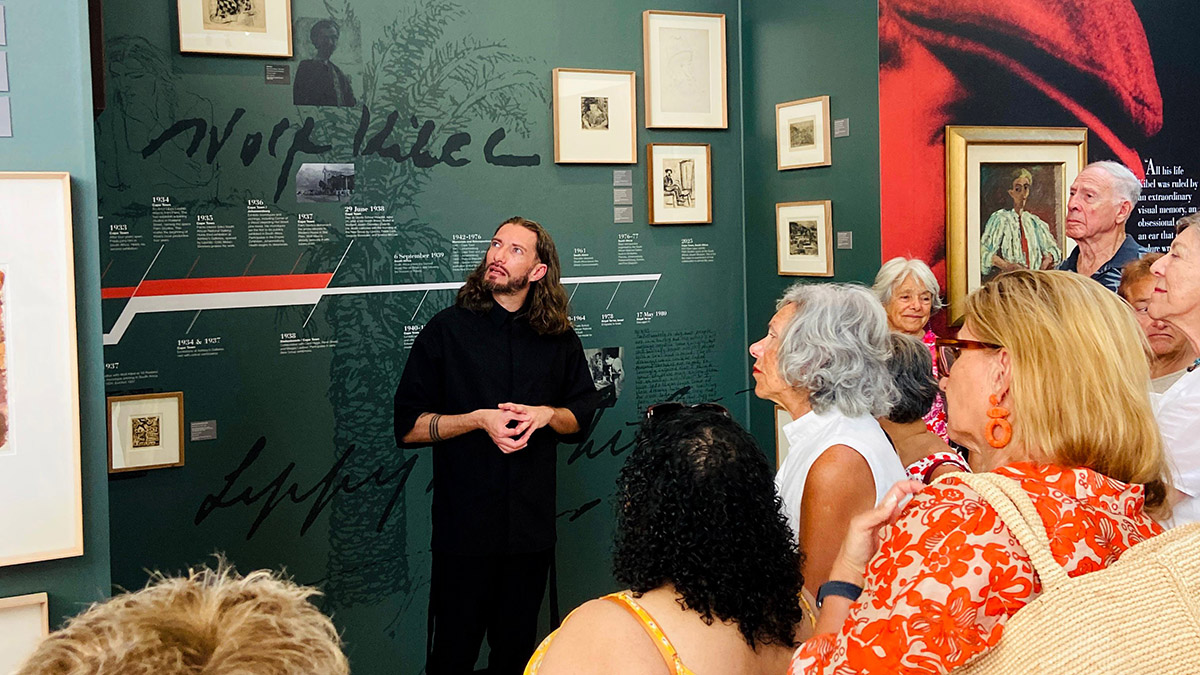
I have attended two walkabouts of the Wolf Kibel Lippy Lipshitz, Palm Studios exhibition currently on at the SA Jewish Museum. Jay van den Berg presents an insightful, knowledgeable, and entertaining view of the two artists and their work. I highly recommend that you join one of the remaining walkabout sessions: Wednesday, 27 May at 10am; and Wednesday, 17 June at 10am.

- For the current edition of the Cape Jewish Chronicle, click here.
- Subscribe to the Cape Jewish Chronicle: R450/year, or R38/month via debit order. Simply email us at subscriptions@ctjc.co.za and click here for payment info.
- The Cape Jewish Chronicle reaches over 6 000 readers monthly across print and digital platforms.
- To book advertising space or discuss a custom package contact Adéle Gradner Mobile: 083 321 5222 | Office: 021 464 6736 | Email advertising@ctjc.co.za