BY KAREN MILLER
At first glance, the story of Shelley Kibel might appear to be one of inheritance: a life steeped in medicine and art, shaped by a lineage of artists, musicians and healers. Her great-uncle, Wolf Kibel, alongside Lippy Lipshitz, the subject of a current exhibition at the Jewish Museum, looms large in the family imagination.
Her mother, Leonora Kibel, worked in mixed media and cultivated in Shelley a sensitivity to visual expression, while her father, Maurice, a well-known and influential paediatrician, was immersed in music through the synagogue, following in the footsteps of his own father, a chazan. Around her, art and music were not pursuits but atmospheres, conditions of being.
A life shaped but not defined by traditions in medicine and art
To describe Shelley Kibel simply as the product of this inheritance would be to miss the point. Her work does not continue a tradition, as much as it quietly resists one. The family legacy is certainly present. The home of her and her husband, Dr David Bass, is filled with their art, Wolf Kibel’s drawings and prints, and her mother’s work, but it serves less as a roadmap than as a kind of gravitational field. One senses both pride and a degree of intimidation in this proximity. David is also a medical doctor, a musician and writer, and their two daughters are both in artistic fields. The connection to her great-uncle is indirect – they never met. Still, his presence is felt, absorbed into the texture of her daily life. The result is not imitation, but a deepened awareness of what it means to find an independent voice within a crowded inheritance.
Medicine as a way of seeing
That voice emerged along an unconventional path. Shelley’s early ambitions leaned toward music; she played the flute and might well have pursued that discipline further. Instead, she turned to medicine, working as a general practitioner in England and later in Cape Town. It was here, in the clinical space rather than the studio, that many of the preoccupations of her later artistic work began to take shape. Her focus on holistic care, on the importance of communication, empathy, and an attention to the psychological and emotional layers beneath physical symptoms, suggests a sensibility already attuned to what lies beneath the surface.
After a twelve-year break from medicine, she was drawn increasingly to palliative care. The encounter with mortality, with fragility, and with the limits of intervention sharpened her sense of the human condition. Medicine, for her, was never merely technical. It was interpretive, relational, and deeply human. In retrospect,
it seems almost inevitable that this perspective would find another outlet.
From anatomy to abstraction
When she turned seriously to art in the 1990s, the transition was less a departure from medicine than an extension of it. Early studies involved drawing the human body, a natural inclination for someone trained in anatomy. But what intrigued her was not structure alone.
It was the energy behind what she observed, the invisible currents animating form.
The result is work that is abstract and decidedly non-representational. Her paintings do not depict so much as evoke. the light behind the trees is the title of her recent exhibition at the Spin Street Gallery, It ran coincidentally and concurrently with the Wolf Kibel/Lippy Lipshitz exhibition at the Jewish Museum. In the works on show her focus shifts from the object itself to the forces that shape perception: feeling, thought, and something more elusive, perhaps spiritual. Her own words describe this orientation: “… (my art) reflects my inner experience…it is about birth, formation, creation, destruction and the transient nature of experience”. It is an art concerned less with what is seen than with what is sensed.
Another of her reflections points to the experiential aim of the work: “The idea is to let go of all expectations and allow light and colour to vibrate and shimmer through your being.” There is, in this, an echo of both medical and artistic practice, the suspension of preconception, the openness to what emerges. Themes of transience recur, but they are not bleak. Words, too, find their way into her practice. Poems often accompany her paintings, arising not as separate compositions but as extensions of the visual process.
A quiet thread of Jewish consciousness
The question of Jewish identity hovers, as it must, in a life so shaped by heritage. Yet Shelley’s art is not explicitly Jewish in subject matter. There are no overt symbols or narratives. Instead, the influence is more diffuse, embedded in what might be called an intellectual and emotional inheritance. There is an awareness of the ‘woundedness’ of Jewish experience, a sensitivity to history and its burdens.
But her focus remains resolutely individual. The work turns inward, exploring personal experience rather than collective identity. There is a subtle alignment with the idea of Tikkun Olam, of repair and healing. Both her medical career and her artistic practice can be seen through this lens. In one, she attended to patients at their most vulnerable; in the other, she engages with the broader questions of existence: creation, destruction, and the possibility of renewal.
Legacy reimagined
In the end, Shelley Kibel’s work resists neat categorisation. It is shaped by tradition but not bound by it, informed by medicine but not reducible to it. What emerges is a body of work and a life that explore the spaces between disciplines, between inheritance and individuality, between the visible and the unseen. It is in these spaces, perhaps, that her true legacy lies.
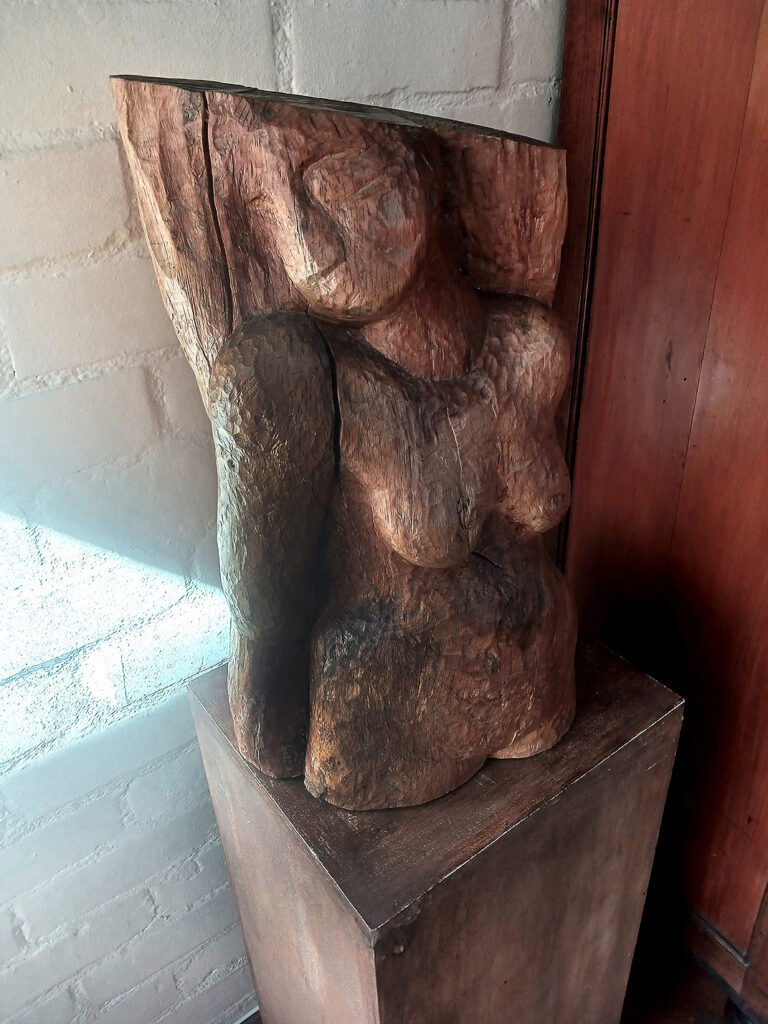
in her home

- For the current edition of the Cape Jewish Chronicle, click here.
- Subscribe to the Cape Jewish Chronicle: R450/year, or R38/month via debit order. Simply email us at subscriptions@ctjc.co.za and click here for payment info.
- The Cape Jewish Chronicle reaches over 6 000 readers monthly across print and digital platforms.
- To book advertising space or discuss a custom package contact Adéle Gradner Mobile: 083 321 5222 | Office: 021 464 6736 | Email advertising@ctjc.co.za