By KAREN MILLER
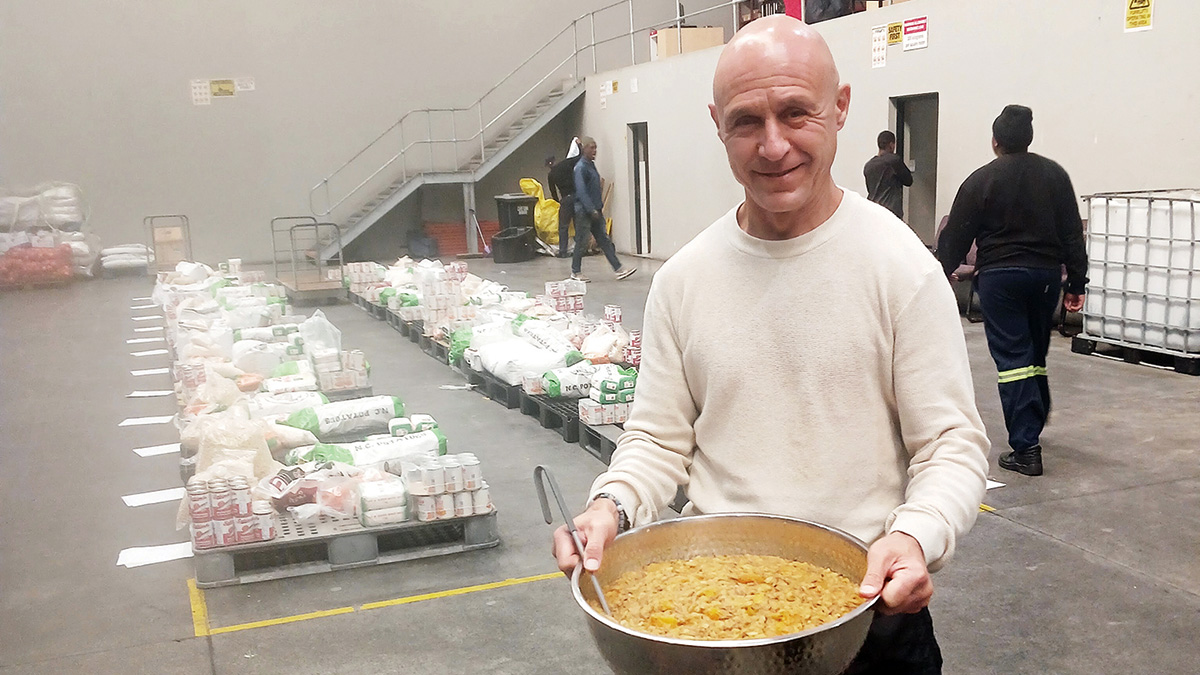
I arrived at Ladles of Love’s warehouse in Epping Industria expecting to interview the founder of one of South Africa’s most remarkable hunger-relief organisations. Instead, I found Danny Diliberto standing over a stove.
It was a Monday, and Mondays have their own ritual at Ladles of Love. Everyone – warehouse staff, packers, sorters, administrators and Danny himself – sits down to lunch together. The meal is cooked on a rotating basis by a member of the team. That day it was Danny’s turn.
I was invited to join them. The menu was simple: curried beans and vegetables with rice, made from the very ingredients distributed to Ladles of Love’s beneficiaries. It was delicious, but more than that, it felt symbolic. There was no separate table for the founder. No executive dining room. Everyone ate together.
The vast warehouse itself surprised me. Warehouses are often noisy, frenetic places. This one radiated order, calm and purpose. Those qualities, I soon realised, reflect the man at its centre.
Most readers will know what Ladles of Love does. Its websitetells the story well enough: nutritious meals for preschool children through Early Childhood Development Centres; the Dignity Kitchen in Roeland Street serving people facing hunger every day; thousands of volunteers, partnerships with farmers, and an organisation, driven as much by data as by compassion. In just the first six months of 2026, more than 13 000 children received nutritious meals through 165 Early Childhood Development Centres, over 51 000 meals were served at the Dignity Kitchen, more than 15 000 volunteers gave their time, R3.8 million supported local farmers, and 330 tonnes of food
were diverted from landfill.
Statistics, however, don’t explain Danny Diliberto.
The day before our meeting, Cape Town had been bracing for an anti-foreign-national march. Friends had collected money to provide food for people who might have to flee violence. I asked Danny whether Ladles of Love could use the donation. He politely declined. The money, he said, should go directly to the organisation co-ordinating relief, and he referred me to the Mensch Network instead. It was a small moment – but it revealed something important. For Danny, partnership matters more than ownership. Helping is not about receiving the credit. His philosophy surfaced repeatedly over lunch.
He talks about creating partners rather than beneficiaries; about relationships rather than transactions. Donors, volunteers, staff and those receiving meals all become part of the same ecosystem. Again and again he returned to the importance of keeping ego in check. As he puts it, things happen “through me, not because of me.”
Danny was born in Zimbabwe. His father came from an Italian background, while his mother is Sephardi, born in the Congo before the family eventually settled in Zimbabwe and later South Africa. His childhood memories are filled with tables groaning under abundant food. Food was associated with generosity and joy. His lunchbox was famously overfilled, and he remembers happily sharing it with classmates.
At eleven he was sent to King David High School in Johannesburg, boarding in the hostel. It was a difficult transition, but one that taught him independence. He remembers one teacher in particular, a Mr Garb, whose consistency and calm left a lasting impression. Those same qualities still underpin the way he leads today.
After school he knew that academia was not his calling. At eighteen he left home, shared a flat with friends and entered the hospitality industry, where food remained at the centre of his life.
Today, his daily routine reflects the discipline that is woven through everything he does. Meditation is non-negotiable. So is exercise, whether running, hiking or going to the gym. Inner peace, he believes, has to be cultivated deliberately. He speaks candidly about letting go of emotions from a turbulent childhood and becoming “comfortable in your discomfort”. Growth, he believes, often comes through challenge.
Underlying his outlook is the Eastern concept of seva – selfless service – which resonates strongly with the Jewish idea of tikkun olam – repairing the world. They come from different traditions, but both insist that spirituality is measured less by belief than by action. A bowl of soup offered with dignity can embody both.
Perhaps nothing illustrates Danny’s intuitive nature more than the early days of the COVID pandemic. Just three days into lockdown, sensing the food crisis that was coming, he posted a simple appeal on social media asking for support. Donations poured in almost immediately. Opportunities seemed to arrive when they were needed, including the warehouse that eventually became Ladles of Love’s home after its temporary base during Covid at Grand West Casino.
The real story of Ladles of Love is not simply about millions of meals. It is about the quiet power of consistency, humility and service. Danny Diliberto has built an organisation that feeds thousands every day, but perhaps his greatest achievement is creating a culture in which dignity is served alongside every meal.
- For the current edition of the Cape Jewish Chronicle, click here.
- Subscribe to the Cape Jewish Chronicle: R450/year, or R38/month via debit order. Simply email us at subscriptions@ctjc.co.za and click here for payment info.
- The Cape Jewish Chronicle reaches over 6 000 readers monthly across print and digital platforms.
- To book advertising space or discuss a custom package contact Adéle Gradner Mobile: 083 321 5222 | Office: 021 464 6736 | Email advertising@ctjc.co.za