Home Blog Page 36

From shtetl to success: Jewish roots in Cape Town

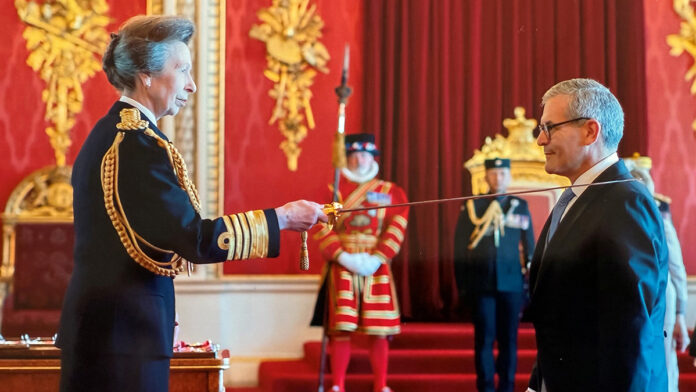
Sir Bradley Fried being knighted by Princess Anne


BY PROFESSOR PHILIP LANZKOWSKY 

Professor Philip Lanzkowsky

Once upon a time in Cape Town – not the bustling city we know today, but a modest port town where fishmongers blew horns in the street and chickens were sold fresh off the feather – there was a thriving little shtetl

It was a place where Jewish immigrants, mostly from Eastern Europe, built humble lives for themselves, with little more than a wagon, a work ethic, and a strong sense of community.

This was my Cape Town.

What makes this story more than just charming nostalgia is what came next: how the children and grandchildren of those immigrants rose from street vendors and butchers to become doctors, professors, psychiatrists, Nobel Prize winners, and even a knighted Governor of the Bank of England. The immigrants were determined that their children would receive a good Jewish and secular education – and it paid off!

Humble beginnings

In the Cape Town of my youth, most shopkeepers were Jewish and catered specifically to the community’s needs. There was a rhythm to the week, a build-up to Shabbat that you could hear, see, and smell. On Thursdays, Mr Schafer’s poultry shop bustled with customers selecting just the right chicken for Friday night dinner, feathers still warm. The discerning women of the shtetl would inspect each one like seasoned judges at an agricultural fair. If something seemed off – as once happened when my mother discovered a strange lump in a chicken – it was taken straight to the rabbi for inspection. (In that case, deemed kosher.)

Horse-drawn carts clattered along the streets, selling blocks of ice or fresh vegetables. One such vendor, Mr Pilowsky, made his rounds with a horse and cart; his son went on to become a professor of psychiatry in Australia. Then there was Mr Katz, a glazer turned baker, who hawked cookies and taygelach along the beach. He moved from being a hawker to the owner of a bakery with two stores. His son? A psychiatrist in the U.S.

My own father became a grocer. Although I had considered becoming a Rabbi, I ended up studying medicine. This profession allowed me to shine, and I have numerous academic and professional accolades behind my name – a far cry from helping my father with grocery deliveries in shtetl Cape Town!

The grandson of the butcher, Mr Fried, whose kosher meat fed the neighbourhood, became Governor of the Bank of England and was knighted by Princess Anne. When asked by a fellow banker if he came from a family of financiers, Bradley Fried quipped, “Not exactly. My father was a jeweller and my grandfather, a kosher butcher.”

In those days, the professionals – lawyers, doctors, bookkeepers – were all Jewish. Dr Berelowitz, one of the local physicians, made house calls with a doctor’s bag in one hand and a bag of change in the other – always ready to make exact change for a grateful patient.

What’s in a name?

Our shtetl was also home to a rich tradition of nicknames – mostly in Yiddish and sometimes hilariously literal. A particular Mr Katz, who was a rather large man, was known as “der grayser Katz” (‘the big Katz’). His son adopted the nickname as his surname – ‘Grayce’ – dropping ‘Katz’ entirely. I once had him as a tutor in medical school, and was surprised to realise the rather humble origins of the elegant-, English-sounding ‘Dr. Grayce’!

Then there was Mr Segal, a stocky carpenter with a limp, known (perhaps insensitively) as “der hinkerdiker” (‘the one who limps’). Despite working among tough dockyard labourers, he became the go-to man for complex problems: “Call the Jew,” they’d say, admiring his skill. His sons? Successful businessmen.

And who could forget “der blinder chazan,” Cantor Abraham Immerman? Despite being blind, he knew the entire Torah by heart and taught generations of boys their Bar Mitzvah portions. Or Mrs Uberstein, “der toyber” (‘the deaf one’), who would trumpet conversations through an ear horn that looked like it belonged in a Victorian drawing room.

Do you remember Cantor Immerman? Share your story about the famed Cantor with our readers. Send your recollection to editor@ctjc.co.za.

A community that rose

What’s truly astonishing is not just how vibrant this little Jewish world was, but how its legacy continues. Out of a community of just 20 000 Jews came an outsized number of professors, innovators, and thought leaders. Three were knighted. One won the Nobel Prize. Many became leaders in science, medicine, business, and academia around the world.

It’s a story of transformation, of rootedness and reinvention. It’s also a story full of charm, character, and characters.

Cape Town’s Jewish shtetl may be a memory now, but its legacy endures – in lecture halls, boardrooms, and hospital corridors across the globe. From fish horns to Nobel Prizes, it’s quite the journey. And I, for one, still hear the echo of Erev Shabbat in my heart. ●


  • For the current edition of the Cape Jewish Chronicle, click here.
  • Subscribe to the Cape Jewish Chronicle: R450/year, or R38/month via debit order. Simply email us at subscriptions@ctjc.co.za and click here for payment info.
  • The Cape Jewish Chronicle reaches over 6 000 readers monthly across print and digital platforms.
  • To book advertising space or discuss a custom package contact Adéle Gradner Mobile: 083 321 5222 | Office: 021 464 6736 | Email advertising@ctjc.co.za

Rediscovering a forgotten past: how two young Poles found their calling in Jewish history

An abandoned Jewish cemetery in the town of Ustrzyki Dolne in South-East Poland

Cape Town Holocaust & Genocide Centre’s Post-Memory tour to Poland

A tour to Poland organised by the Cape Town Holocaust & Genocide Centre (CTHGC) is on the go as the Cape Jewish Chronicle team prepares its August edition. In the next few editions of the CJC, we bring you news and opinions about the tour, current attitudes in Poland regarding the country’s Jewish past, and the experiences
of those who joined the tour.

Organised and led by the Director of the CTHGC, Jakub (Kuba) Nowakowski, and with the involvement of a number of tour guides, including Kuba’s wife, Gosia, the tour sees 14 participants from various parts of the world take in the Jewish history and current scenarios in Poland.

In the first of our articles, we asked Kuba and Gosia, who were both brought up in Catholic homes in Poland, what drew them to their country’s Jewish past.

For Kuba and Gosia, growing up in post-Communist Poland meant living among silent stones – buildings, synagogues, and cemeteries that hinted at a vibrant Jewish past but stood largely unacknowledged in everyday life. 

It would take years, and a series of unexpected discoveries, for them to realise just how deeply intertwined that past was with their own stories – and to devote their professional lives to uncovering and preserving it.

Kazimierz without memory

Kuba was born in 1983 in Kazimierz, Krakow – a district today recognised as one of Europe’s best-preserved Jewish quarters. But as a child, the presence of that Jewish past
was all but invisible.

“My family had lived in Kazimierz for generations,” he recalls. “We were Catholic, a minority in what had once been a Jewish-majority neighbourhood. But none of that history was spoken about. The synagogues were there, but no one mentioned what they were or who had once filled them.”

Gosia heard titbits about the Jewish past of her hometown, Nowy Targ (called Naymark in Yiddish), from her grandmother, who recounted anecdotes of life in the town before the War. (The town had in fact been 60% Jewish, a fact Gosia learned later on.)

The interest sparked by her grandmother’s recollections was deepened by a school history teacher, who defied Communist-era taboos and refused to ignore the realities of the town’s Jewish history. “This teacher was a wonderful bridge to the past,” Gosia explains. “She was a great storyteller – and my interest definitely comes from her prompting.”

For Kuba, it wasn’t a teacher who first sparked his awareness of Jewish history – it was a football. “We were playing soccer one day and the ball flew over a wall,” he says. “We climbed over and found ourselves in an overgrown cemetery filled with mysterious gravestones carved with what looked to us like hieroglyphs. It felt like Atlantis. Something lost.”

That moment stirred something. Who were the people buried there? What had happened to them?

Hollywood comes to town

Later on, another event would shake Kuba’s understanding of his neighbourhood – and his nation’s past – more profoundly.

“When Steven Spielberg came to Krakow to shoot Schindler’s List, everyone was buzzing. He had just made Jurassic Park, and suddenly this global celebrity was filming in our dilapidated part of town. We were intrigued.”

But when the film premiered in 1993, the reaction in Krakow was less excitement than confusion and shock.

“No one had prepared us for what we saw. The film showed a Krakow we didn’t recognise – a city where Jews once lived in vast numbers, where they were persecuted and deported, and where Polish bystanders weren’t always heroes. That was a major rupture in how we understood ourselves.”

The infamous scene in which Polish children jeer at Jewish families being deported from Kazimierz hit hard. “It forced a confrontation,” Kuba says. “We had to start asking questions. About our families, our schools, our neighbourhoods. About why no one had told us any of this.”

From curiosity to commitment

For both Gosia and Kuba, those early questions turned into a lifelong quest. Both enrolled in the Jewish Studies Department at Jagiellonian University in Krakow. Kuba also began working with NGOs that brought together youth from Poland, Israel, and the United States to explore shared histories and dialogue across painful divides.

“At the time, it wasn’t a typical path,” he reflects. “Jewish history wasn’t exactly a booming career field. But for those of us drawn to it, it wasn’t about careers. It was about finding answers to things that had been hidden for too long.”

Among those fellow students was Gosia. Like Kuba, she grew up Catholic in a place where the Jewish story had been erased – but where traces remained if you knew where to look.

“She, too, had questions,” Kuba explains. “What happened to the Jews who once lived in her town? Why had their memory disappeared?”

As they studied together, Gosia and Kuba uncovered strange details in their own family lives – Yiddish words slipped into their parents’ vocabulary, Jewish dishes appearing each year on the Christmas Eve dinner table, unexplained absences of classmates in the late 1960s (a result of the anti-Semitic purge of 1968, when many Jews were forced to leave Poland).

“It slowly became clear that even though our families were Catholic, there were echoes of Jewish life everywhere. We had just never known how to hear them.”

History as responsibility

What began as personal curiosity soon became a professional calling. Both joined a growing movement in Poland – led largely by non-Jewish scholars, educators, and activists – dedicated to rediscovering, preserving, and teaching the history of Polish Jews.

“After completing my studies,” Gosia says, “I worked for 10 years in the Galicia Jewish Museum. Subsequently, I became a tour guide with a focus on the Jewish history of Poland.” Her interest in Jewish culture is reflected in her Master’s thesis: an examination of the crossover between Polish and Yiddish theatre before the War.

Their work spans education, cultural preservation, and international dialogue. They lead study trips, curate museum exhibits, and create platforms for young people to explore the layered and often difficult past they’ve inherited.

And over the years, they’ve seen a shift.

In the early 2000s, Jewish heritage in Poland started attracting more attention – partly because of increased tourism, and partly because international businesses, including Israeli companies, began to invest there. “But for many of us,” Kuba says, “it still wasn’t about tourism or job prospects. It was about truth.”

Remembering for the future

Today, Poland is a country where Jewish history is more present than it was in Kuba and Gosia’s youth – but where debates over memory and identity remain charged and unresolved. That’s exactly why, they argue, the work is far from over.

“Poland was once home to the largest Jewish population in the world,” Kuba says. “And then it became the epicentre of the Holocaust. That’s not just a historical fact – it’s a moral and cultural reality that shapes who we are today.”

For Kuba and Gosia, studying Jewish history is not just about honouring the past – it’s about building a future in which memory, complexity, and empathy guide the next generation.

“Our parents didn’t ask these questions,” Kuba says. “But we did. And now, we’re helping others to ask them too.” ●

Impact of the Holocaust on Poland

Kuba: “Poland once was the absolute centre of the Jewish world; then it became the absolute epicentre, a Ground Zero of Jewish death. This means that the country that once had the largest Jewish population in the world today has one of the smallest.”

Gosia: “I very much believe that Poland is poorer in a number of ways because of what happened.  Poland lost a wonderful, interesting culture; it lost so much that enriched both our nations. The country lost many ordinary people, but also many intellectuals and thinkers. I often think about where my country could be if not for that. It’s a terrible loss. Poland would definitely be a much, much better place, I believe.”

When the past becomes a battlefield: Holocaust memory in a divided Poland

In Poland today, the study and commemoration of Jewish history – and particularly of the Holocaust – is not just an academic or cultural pursuit. It has become, in many ways, a reflection of a broader ideological divide within the country. The past is no longer a settled matter; it is a battlefield, where different visions of Polish identity and national pride clash.

On one side stands the liberal, pro-European segment of Polish society. For these individuals, confronting the darkest chapters of the nation’s past – especially the complex and painful history of Polish-Jewish relations during the Holocaust – is not seen as an act of self-criticism, but as an act of courage. They believe that truth-telling strengthens a nation. Acknowledging complicity, recognising the suffering of others, and making space for nuance are, in this view, essential to building a democratic and inclusive future.

On the other side is a deeply conservative current, often rooted in nationalist, religious, and Eurosceptic worldviews. For this group, the past is not something to be interrogated or complicated – it is a source of glory and pride, a narrative to be protected. In this view, any suggestion that Poles may have participated in the persecution or betrayal of Jews during the War is seen as a dangerous attack on the nation’s honour. Myths of resistance, heroism, and moral purity are held tightly, and efforts to challenge these myths are met with strong resistance – even legal repercussions.

It is within this divided landscape that historians, educators, and cultural activists work today. As one observer put it, “It is not the future that is uncertain – it is the past that keeps changing.” The struggle over Holocaust memory in Poland is not just about what happened decades ago. It is about who Poles are today, and who they wish to become. 


  • For the current edition of the Cape Jewish Chronicle, click here.
  • Subscribe to the Cape Jewish Chronicle: R450/year, or R38/month via debit order. Simply email us at subscriptions@ctjc.co.za and click here for payment info.
  • The Cape Jewish Chronicle reaches over 6 000 readers monthly across print and digital platforms.
  • To book advertising space or discuss a custom package contact Adéle Gradner Mobile: 083 321 5222 | Office: 021 464 6736 | Email advertising@ctjc.co.za

United in Israel, in Jewish solidarity

In a moving display of unity and resilience, 21 Jewish women (mostly mothers) from Cape Town joined nearly 280 women from 15 countries across the globe as part of Momentum’s Journey of Growth – a powerful eight-day trip to Israel designed to empower women with Jewish values, identity, and global responsibility in the wake of October 7th.

The Momentum Journey of Growth provides participants with the inspiration to connect to Jewish values, engage more deeply with Israel, and gain the confidence to take action by standing up and speaking out when they return to their home countries. The mission included participants from South Africa, India, Venezuela, France, Canada, the U.S., and Spain. 

Participant Pam Tudin-Buchalter from Knysna comments that, “It is difficult to understand the true definition of resilience until you have seen Israelis post-October 7. We met kibbutz women who, after losing their husbands to Hamas terror, chose to build a magnificent healing centre for women on the same land where their husbands were murdered.”

Pam also says that she understood what the phrase ‘They choose life’ really means. “Despite the brittleness that sometimes comes from being in a state that is marked every day by a need for survival, somehow in Israel it seems to have been replaced with everyone’s desire to show up in their power, good power. I was aware of how the average Israeli in the street still demonstrates an incredible capacity for joy, even humour.” 

The tour itinerary included a visit to southern Israel, where they bore witness to the trauma and resilience of Israeli families near the Re’eim Nova site. The visit included storytelling, volunteer work, and deeply emotional encounters with survivors and residents rebuilding their communities. They also toured the Jewish Quarter of the Old City in Jerusalem, and danced and prayed at the Western Wall.

“Seeing the swearing in of new soldiers at the Kotel was very meaningful,” commented Elanit Judes.

For Elanit, the insights gained into a number of issues were particularly valuable. For instance, the devastating economic impact of the decline in tourism since October 7th was highlighted in a visit to Jerusalem’s famous shuk. “It was also a learning experience to come across Jewish women from other countries who know so little about Judaism,” she explained. “Some knew nothing about the lighting of Shabbat candles!”  

The stories of courage, grief, and strength that these women heard first-hand remind us why standing with Israel is so essential. ●


  • For the current edition of the Cape Jewish Chronicle, click here.
  • Subscribe to the Cape Jewish Chronicle: R450/year, or R38/month via debit order. Simply email us at subscriptions@ctjc.co.za and click here for payment info.
  • The Cape Jewish Chronicle reaches over 6 000 readers monthly across print and digital platforms.
  • To book advertising space or discuss a custom package contact Adéle Gradner Mobile: 083 321 5222 | Office: 021 464 6736 | Email advertising@ctjc.co.za

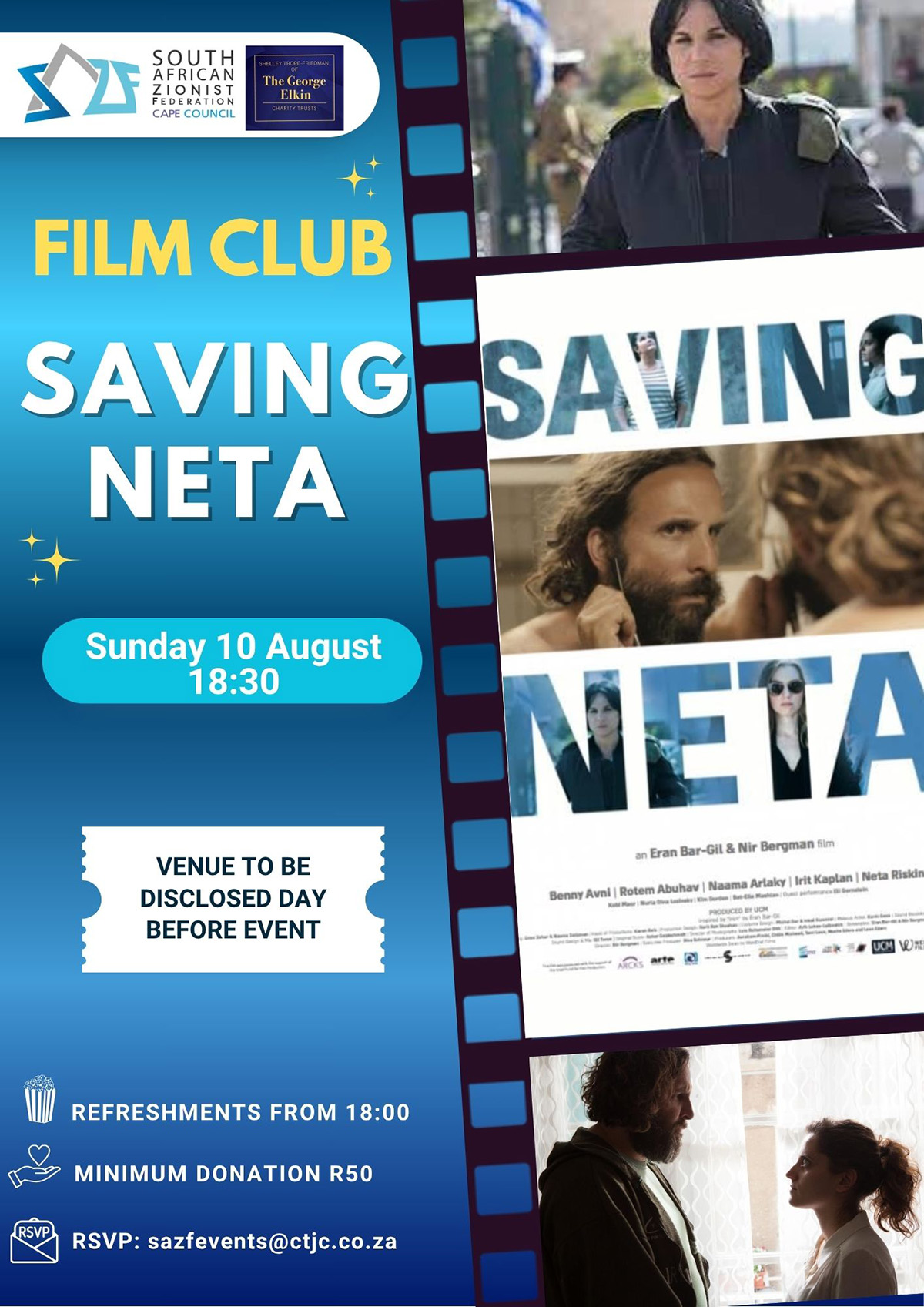
Film Club: Saving Neta

A still from Saving Neta (photography: Eitan Riklis)

10 August, at 18:30

Saving Neta (2016), directed by Nir Bergman, is an Israeli drama about four women whose lives intersect through a drifting stranger named Neta. Each faces a personal crisis, and their stories mirror and resolve each other’s questions, exploring femininity, parenthood, and human connection. Noted for its authentic female relationships, the film won the Audience Award at the Jerusalem Film Festival the year of its release.Watch the Saving Neta trailer.

SA Zionist Federation – Cape Council – Facebook | Twitter | Instagram


  • For the current edition of the Cape Jewish Chronicle, click here.
  • Subscribe to the Cape Jewish Chronicle: R450/year, or R38/month via debit order. Simply email us at subscriptions@ctjc.co.za and click here for payment info.
  • The Cape Jewish Chronicle reaches over 6 000 readers monthly across print and digital platforms.
  • To book advertising space or discuss a custom package contact Adéle Gradner Mobile: 083 321 5222 | Office: 021 464 6736 | Email advertising@ctjc.co.za

Limmud 2025

Why does this conference differ from all other conferences?

Limmud http://www.limmud.org.za | registration@limmud.org.za


  • For the current edition of the Cape Jewish Chronicle, click here.
  • Subscribe to the Cape Jewish Chronicle: R450/year, or R38/month via debit order. Simply email us at subscriptions@ctjc.co.za and click here for payment info.
  • The Cape Jewish Chronicle reaches over 6 000 readers monthly across print and digital platforms.
  • To book advertising space or discuss a custom package contact Adéle Gradner Mobile: 083 321 5222 | Office: 021 464 6736 | Email advertising@ctjc.co.za

Understanding and managing challenging behaviours in children

JCS@WORK Renee Donneson, Social Worker

Parenting can be an amazing and fulfilling experience, but it can come with obstacles and challenges. Parents can experience difficulties in the management of their children’s challenging behaviors, and this can result in stressful situations.

These behaviors can result in tantrums and defiance. It is important to note that when a parent is faced with a child with challenging behaviors, it is imperative to approach the situation with empathy and understanding.

Strategies for parents to manage challenging behaviors:

•     Self-reflection
Reflect on your own emotion and reactions when faced with challenging behaviors. It is important to note that modelling calm behavior will facilitate containing the outburst.

•     Positive Reinforcement
When the child demonstrates positive behavior, the parent needs to show praise and acknowledgement thereof. This builds self-esteem and resilience

•     Clear and Consistent Boundaries
Clear boundaries create consistency and establish rules for appropriate behavior.

•     Effective Communication
The use of age-appropriate language to communicate the expectations of appropriate behavior is essential. Active listening facilitates understanding and cooperation.

•     Create a Calming Environment
Create a space in the family home that can provide a space to calm down and regulate the child’s emotions and provide containment.

•     Encourage Independence
Provide a space to make choices and take responsibility and ownership of the choices. This fosters the child’s sense of autonomy .

•     Problem Solving Skills
Encourage the child and provide assistance to effectively problem solve. This will assist the child to explore and develop alternative solutions and reduce outbursts. This is an essential strategy.

•     Time and Connection
When the child displays tantum type behavior and has a meltdown, remain close to the child and provide comfort. This provides the child with a safe space to self-regulate and feel secure.

Should challenging behaviors persist, it is strongly advised that parents need to seek professional assistance.

Jewish Community Services is a designated Child Protection Organization and as such we can intervene and assist parents and children with further strategies to address changing behaviors and seek alternative solutions.

If you would like further information from our social workers, please contact the office

on 021 462 5520 or email info@jcs.org.za

Jewish Community Services website: http://www.jcs.co.za | JCS Facebook | JCS Instagram


  • For the current edition of the Cape Jewish Chronicle, click here.
  • Subscribe to the Cape Jewish Chronicle: R450/year, or R38/month via debit order. Simply email us at subscriptions@ctjc.co.za and click here for payment info.
  • The Cape Jewish Chronicle reaches over 6 000 readers monthly across print and digital platforms.
  • To book advertising space or discuss a custom package contact Adéle Gradner Mobile: 083 321 5222 | Office: 021 464 6736 | Email advertising@ctjc.co.za
August 2025 community events

Community OrganisationEventDateRSVP
SAZF Cape CouncilFilm ClubSunday, 10 Aug, 18H30RSVP: sazfevents@ctjc.co.za
Cape Town Holocaust & Genocide CentreWebinar: Jens Christian WagnerThurs, 21 Aug, 19H00RSVP: admin@holocaust.org.za
Midrasha Melton6 Online Sessions: Zionism with Ronnie GotkinWednesdays, Aug 13, 20, 27, Sep 3, 10, 17 19H15-21H00RSVP: lauren@snitcher.org
Cape Town Holocaust & Genocide CentreTalk: Yochai Cohen, Yad Vashem, on ‘October 7 and the Israeli Holocaust Consciousness’ Mon, 25 Aug, 18H00RSVP: admin@holocaust.org.za
LimmudConferenceSat, 23 – Sun, 24 Aug, TBCRSVP: registration@limmud.org.za
MidrashaMelton3 Online Sessions: The Bard & The Bible with David Levin-KrussThursdays, Aug 28, Sep 4, 11 19H30-21H00RSVP: lauren@snitcher.org
SAZF Cape CouncilTalk: ‘Peace starts with the truth’Sunday, 31 Aug, 18H30RSVP: sazfevents@ctjc.co.za
Cape Town Holocaust & Genocide CentreCreative Project AwardsSunday, 31 Aug, 17H00RSVP: admin@holocaust.org.za


  • For the current edition of the Cape Jewish Chronicle, click here.
  • Subscribe to the Cape Jewish Chronicle: R450/year, or R38/month via debit order. Simply email us at subscriptions@ctjc.co.za and click here for payment info.
  • The Cape Jewish Chronicle reaches over 6 000 readers monthly across print and digital platforms.
  • To book advertising space or discuss a custom package contact Adéle Gradner Mobile: 083 321 5222 | Office: 021 464 6736 | Email advertising@ctjc.co.za

Connect with experienced mentors

Read to unlock your potential? Join ORT SA CAPE Jet’s Mentorship Programme.

ORT SA Cape Jet http://www.ortjetcapetown.org.za


  • For the current edition of the Cape Jewish Chronicle, click here.
  • Subscribe to the Cape Jewish Chronicle: R450/year, or R38/month via debit order. Simply email us at subscriptions@ctjc.co.za and click here for payment info.
  • The Cape Jewish Chronicle reaches over 6 000 readers monthly across print and digital platforms.
  • To book advertising space or discuss a custom package contact Adéle Gradner Mobile: 083 321 5222 | Office: 021 464 6736 | Email advertising@ctjc.co.za

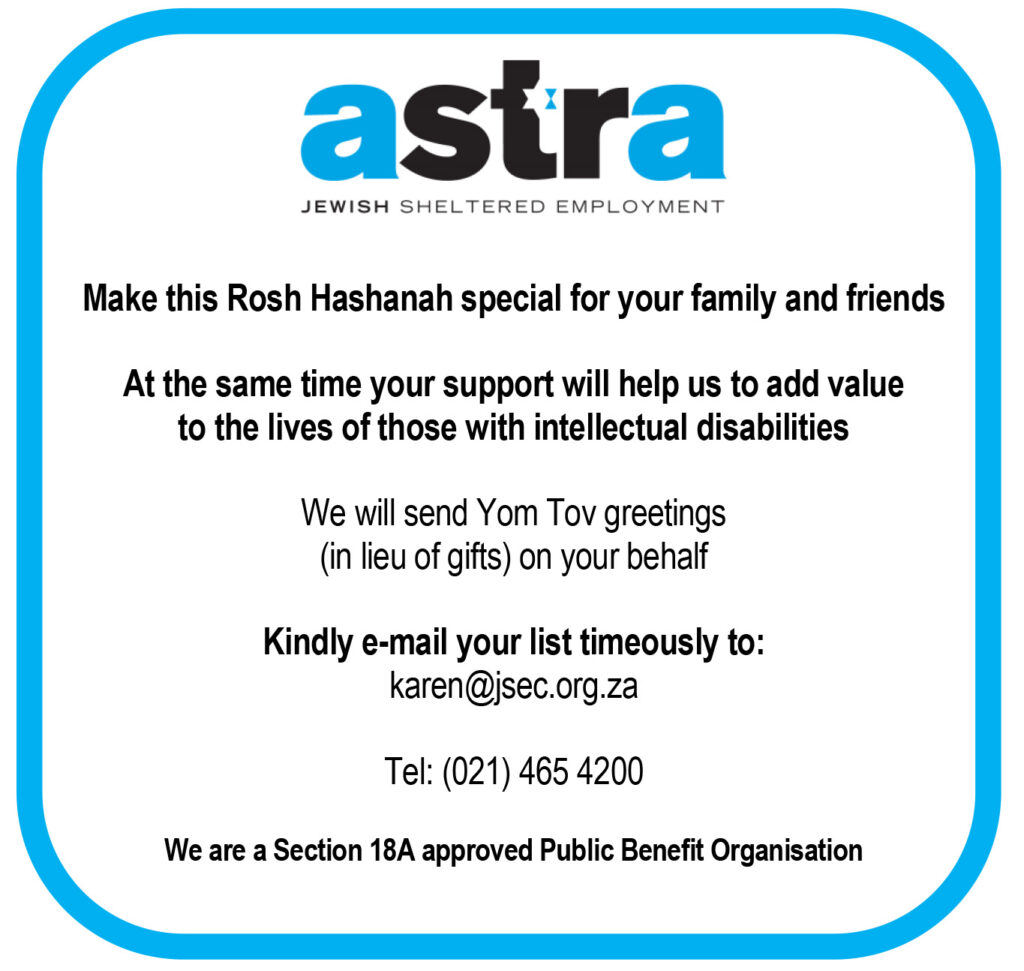
Yom Tov greeting service

Astra Jewish Sheltered Employment
20 Breda Street, Gardens | 021 461 8414 | Email: coffeetime@jsec.org.za | https://astrajse.com/shop/


  • For the current edition of the Cape Jewish Chronicle, click here.
  • Subscribe to the Cape Jewish Chronicle: R450/year, or R38/month via debit order. Simply email us at subscriptions@ctjc.co.za and click here for payment info.
  • The Cape Jewish Chronicle reaches over 6 000 readers monthly across print and digital platforms.
  • To book advertising space or discuss a custom package contact Adéle Gradner Mobile: 083 321 5222 | Office: 021 464 6736 | Email advertising@ctjc.co.za

Share a sweet greeting with a heartfelt touch

Glendale home website, email, phone: +27 (0)21 712 0270


  • For the current edition of the Cape Jewish Chronicle, click here.
  • Subscribe to the Cape Jewish Chronicle: R450/year, or R38/month via debit order. Simply email us at subscriptions@ctjc.co.za and click here for payment info.
  • The Cape Jewish Chronicle reaches over 6 000 readers monthly across print and digital platforms.
  • To book advertising space or discuss a custom package contact Adéle Gradner Mobile: 083 321 5222 | Office: 021 464 6736 | Email advertising@ctjc.co.za

SIGN UP TO RECEIVE THE CAPE JEWISH CHRONICLE