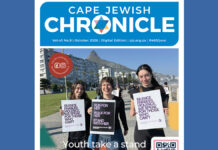
– Young Jewish South Africans share their hopes, fears and dreams
By JESSICA JANTJIES
Rabbi Matthew Liebenberg explains that the sages believed that children’s words contained divine insight, prophetic echoes of what the world needed to hear. He says, “Children retain a vague prophetic intuition,” and perhaps, in hearing them, we learn something deeper about ourselves and our society.
In the spirit of this tradition, we listened to young Jewish voices from across Cape Town – Orthodox and Progressive, religious and secular – on their visions for the future, their fears, and their hopes for Jewish life in South Africa and beyond.
“Not Really” – A phrase repeated more than once
For many young people, the idea of building a life in South Africa feels uncertain. One youth shared, “I think my future looks like I’ll be away from my birth country and reside elsewhere.” A young adult from Bnei Akiva echoed the sentiment: “I want to be in a country where I don’t have to hide my identity… I want to feel safer.”
For these youth, the pull of Israel is strong, not only for spiritual reasons but for security and a sense of belonging. “I feel a spiritual connection like nothing before,” said Hannah Jantjies, Netzer Rosh Cape Town. “Israel is a second home.” Another mentioned feeling “safer than when in South Africa” when in Israel, despite the country’s complex security landscape.
Interestingly, Germany was also mentioned as a future destination by one young adult, who described it as a place that felt “understanding and safer”. For Aziza Rasalanavho, Netzer Gizbar, the dream is Italy: “It embodies the idea of love in all forms to me… I have it in my mind that being there will help me be more human than a category of human.”
Education and careers: hope with hesitation
Despite political and economic instability, South African universities, particularly UCT, are still seen as world-class institutions. “UCT really pushes you and gives you a deep understanding of your degree,” said one youth. But opportunities after graduation are less certain.
Still, others point out the support systems that come with being Jewish in South Africa. “There are so many options, help, and support,”said Hannah. “We’re one big community, and we build each other up.”
Antisemitism: Seen and unseen
For some, antisemitism is an ever-present concern. “If it costs a life, then it is threatening,” one young adult stated bluntly. “I think in a matter of seconds, someone can die… Hatred at its pure form.”
Others, however, express a more nuanced concern, not of external hatred, but internal exclusion. Aziza, who identifies as a Jewish African woman, says she’s rarely targeted by external antisemitism, but worries more about being accepted within the community itself. “People don’t believe that I am Jewish, so it doesn’t really affect me much. But… the denial of the legitimacy of my Jewish heritage from the Jewish community concerns me. I fear I won’t be taken seriously.”
Her words are a powerful reminder: antisemitism isn’t only something we look for outside of our community – it can also manifest in who we choose to include or exclude within our own walls.
Community as anchor – and mirror
Yet despite the challenges, these young people still find meaning and strength in their Jewish connections.
“Being in the Jewish community in South Africa is very good for me,” said Aziza. “We help each other see more of the goodness in life as well as the seriousness of tikkun olam and good dugma (example).”
Others speak warmly of the power of Jewish networking, what one youth called “Jewish geography”. Hannah explained: “You’re one big family in this world… You lean on each other. There’ll always be room for connection, whether it’s because you’re just Jewish or because you’re friends with a family friend.”
That interconnectedness, that sense of always having “a family away from home,” is what keeps many engaged in Jewish spaces, even as they plan lives elsewhere.
A call to listen
Rabbi Liebenberg reminds us that during the Purim story, when faced with an existential crisis, Mordechai turned not to sages, but to children. And they offered reassurance. Their words guided him and us toward hope.
Likewise, today’s Jewish youth offer both caution and clarity. They speak of safety, of dreams, of exclusion, of identity. They challenge us to make our communities more open, more supportive, and more visionary.
In Rabbi Liebenberg’s words, “The future belongs to the young. We would do well to listen.” ●
Let the youth speak. Let us listen. And let us act.
- JUNE 2025: Read the June 2025 Digital Edition in your browser as a Flipbook or a PDF.
- SUBSCRIBE: Subscribe to the Cape Jewish Chronicle for just R450/year (or R37.50/month debit order) and you will remain connected. Simply email us at subscriptions@ctjc.co.za and click here for payment info.
- ADVERTISE in the Cape Jewish Chronicle and on this website. Contact Lynette on 021 464 6736 or email advertising@ctjc.co.za.