The Cape Town Jewish community includes a unique congregation known as Kehilat Tikva Tova.
For the past 20 years, the congregation has run Egalitarian Orthodox services, which follow the Orthodox Service for Rosh Hashana and Yom Kippur, while embracing gender equality. Men and women count for a minyan, daven, are given an Aliyah to read from the Torah, and all may enjoy the honour of opening the Ark.
Our services are participative (and somewhat shorter than most traditional services) while the sermons are directed at making our tradition relevant to the context of our times.
For the current edition of the Cape Jewish Chronicle, click here.
We at the Gitlin believe that access to books should never be blocked by technology skills or income. When more people can read, reflect and connect our entire world grows stronger. May our books help to sweeten your New Year.
Reviews by JACQUI RODGERS Director, Jacob Gitlin Library
SIX DAYS IN BOMBAY by ALKI JOSHI. When renowned painter Mira Novak arrives in a Bombay hospital after a miscarriage, her nurse Sonia is excited to learn more about the vivacious artist who shares her half-Indian identity. When Mira dies unexpectedly Sonia falls under suspicion. The key to prove her innocence may be in a cryptic note and four paintings Mira left in her care. She visits Mira’s former friends and lovers across Europe.The book is based on Amrita Sher-Gil, the Frida Kahlo of India.
CHILDREN OF RADIUM by JOE DUNTHORNE. A riveting memoir about Dunthorne’s German-Jewish great grandfather who had been a chemist in 1933 outside Berlin. Siegfried Merzbacher’s work began in the toothpaste industry, but his development of radioactive household products led him to produce chemical weapons and gas mask filters used by the Nazis. Although he successfully escaped to Turkey with his immediate family, many family members left behind were murdered in Auschwitz.
ON DEMOCRACIES AND DEATH CULTS-ISRAEL, HAMAS AND THE FUTURE by DOUGLAS MURRAY. He confronts the pressing issue that Western support of the Palestinian cause is playing into a more dangerous force. He takes readers through the aftermath of 7 October 2023 with accounts from victims, survivors and terrorists. He argues that Israel’s commitment to Western values has made it a beacon of progress.
THE NAZI MIND by LAURENCE REES. Renowned British historian Rees explores how the unthinkable became normal, and ordinary Germans tolerated the removal of the Jews. Rees charts the rise of Nazi mentalities including the conditions that allowed this ideology to flourish and the sophisticated propaganda that sustained it. He uses previously unpublished testimonies from former Nazis and those who grew up in the Nazi system providing in-depth psychological insights.
MASTERING AI by JEREMY KAHN. Kahn expounds how AI is likely to change art, education and the workplace. He provides an assessment of AI’s abilities and shortcomings suggesting that while the software may help artists with generating ideas it cannot produce anything novel without human input. It could expand educational possibilities but because of its writing ability degrade the human ability to think creatively.
A SWEET YEAR by JOAN NATHAN. The book opens with an introduction to kashrut and follows with a section of each of the nine Jewish holidays suggesting menus and blessings for each one. The recipes in the book are planned so that adults and children may cook together. Many of the recipes can be vegetarian or meat and some dishes are less highly spiced for children’s tastes. It reflects Nathan’s travels and lifelong interest in the foods of Jewish groups throughout the world.
THE SUNFLOWER HOUSE by ADRIANA ALLEGRI. Strauss has an idyllic life until she finds that her birth mother was Jewish, making her a Mischling. She is forced into service at a state-run baby factory where she witnesses and participates in Himmler’s ruthless eugenics program. Allina must keep her identity secret, but when she discovers the neglect occurring, she is determined to save herself and the children in her care.
Wishing you a happy Rosh Hashanah. We hope our CJC greeting services are a helpful & enjoyable addition to your holiday. Please share the support of these wonderful community initiatives featured here.
At the heart of ORT SA CAPE’s JET mentorship programme lies an understanding that transformation happens in conversation.
As mentors and mentees meet in boardrooms and coffee shops across Cape Town, the true art of mentorship unfolds –changing lives through dialogue.
“I’ve trained myself to become an active listener,” explains Michael Sternberg, a veteran mentor whose years in business have given way to a second calling. “The most challenging part is concentrating intently and focusing on the main problem of the mentee.” He watches for subtle cues – body language, facial expressions, the fluency and relevance of responses – all vital elements in mentorship. This focus allows for transformation.
Seasoned business mentor Arnie Witkin comments that, “The mentee nearly always knows the answers – they just sometimes don’t know where to look.” His approach involves asking deep, penetrating questions – like “shining a light in a dark cave” – illuminating paths forward previously hidden in shadow.
The journey isn’t always straightforward. Leor Atie acknowledges one of mentorship’s primary challenges: “The limited time spent with a mentee means the ability to extract and discuss key issues isn’t always possible.” But even brief encounters may yield results. “Sometimes a different perspective or experience shared can really assist mentees in their decision-making process.”
The impact of these interactions can be life-changing. Witkin recalls a mentee whose personal and business challenges were overwhelming. “She thought she was operating at 5%,” he shares. However, by asking deep questions and shining a light on the evidence, she realised she was closer to 75% and that she had what it took to succeed. Within weeks, her confidence had transformed; later, she secured a business partner and investor.
The rewards for mentors themselves run deep. “After a lifetime in business, it’s been tremendously uplifting and fulfilling to contribute towards the positive improvement of others,” Sternberg comments. Attie echoes this sentiment: “It’s very rewarding when a mentee appreciates the time spent with them and seeing how one’s input can assist with their decision-making and clarity of thought.”
For mentorship to be successful, a safe, trusting environment is necessary. “Stress confidentiality before each meeting,” advises Witkin. “The mentee must feel they are in an emotionally safe space.”
This foundation of trust allows the relationship to deepen over time. “As trust develops,” Atie notes, “the quality of the conversation generally improves.” Also, effective mentorship requires humility. “It’s all about the mentee – you must have no ego,” Witkin emphasises. Rather than offering direct advice, successful mentors share experiences and insights, allowing mentees to reach their own conclusions about the optimal path forward.
The ORT SA CAPE JET mentorship programme demonstrates that intentional, humble guidance transforms entrepreneurs and strengthens their businesses. Purposeful mentorship can have a profound impact on a mentee.
Shalom to our new shlichot and shinshinim! We are delighted to welcome our new Shinshinim and Zionist Seminar Shlichot to the Cape Town Jewish community!
Arriving from Israel with energy, curiosity, and a deep passion for Jewish life, they join us to share their personal stories, culture, and experiences in creative, inspiring ways. Over the coming year, they will bring Israel to life in our schools, youth movements, and community spaces. We look forward to learning, celebrating, sparking conversation, building friendships, and creating memories together – deepening our understanding of Israel and strengthening the bonds between our communities. In true Cape Town spirit, we welcome them as family, ready to learn, laugh, and grow together.
Heather Blumenthal, Executive Director SAZFCC
Meet the team
Hello everyone, my name is Mika. I am 17 years old and from Yokne’am Illit (in Northern Israel). I am beyond excited to open the shinshinim programme in Cape Town and get to know and work with many different parts of your Jewish community.
Hello everyone! My name is Amit, I am 23 years old and am more than happy to be back in Cape Town for my second shlichut. In Israel, I live in Ness Ziona and am a university student at Reichman, studying diplomacy and international affairs. I can’t wait to get to meet you all and make many more amazing memories together!
Hi! My name is Zohar, I’m 24 years old and I’m from Afula. I’ve recently finished my military service and will be attending university in the upcoming semester at Ariel University. I will be studying psychology and criminology. I’m currently in Cape Town to get to know the Jewish community deeper, make connections and friendships that will last. I’m really excited about everything that’s ahead!
Hi! My name is Eliya, I’m almost 18 year’s old and I’m so very excited to be here in Cape Town! I’ve just graduated from high school, I’m the eldest sister of three and I’m from Afula, a city in northern Israel. I can’t wait to meet everyone and get to know the community, share my culture from Israel, and also learn from all of you about the community!
Jewish communities outside Israel are now almost entirely urban – in cities such as New York, London, Paris, and Cape Town. Yet history tells a richer story: we once lived not only in bustling cities (when permitted) but also in small towns and remote villages across the globe.
Travellers in Europe often stumble across reminders of this heritage – an Ulica Żydowska, La Giudea, or Calle Hebraica – and feel a thrill of recognition. I have felt it myself on visits to towns in Spain, Portugal, and Eastern Europe.
What’s striking is that it’s not only Jews who respond warmly to these traces. On a recent tour to Poland with the Cape Town Holocaust & Genocide Centre (CTHGC), I saw how local non-Jewish residents take responsibility for abandoned sites reflecting their town’s Jewish past – a past almost erased by the Nazi occupation.
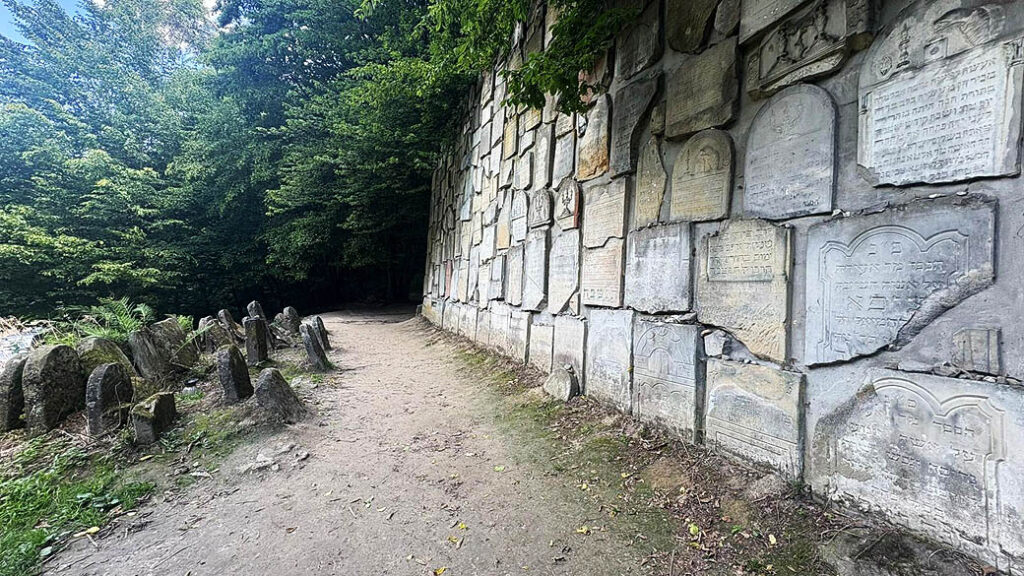
In some places, these sites are coming back to life. We visited the old synagogue in Łańcut, near Tarnów, lovingly cared for by an elderly Polish man who has learned Hebrew; a cemetery in Kazimierz Dolny, restored by a local man who built a memorial wall from old tombstones; and the Jewish Museum in Oświęcim, created by non-Jews in tribute to the community that once lived there.
I had seen this spirit before in a documentary brought to Cape Town by the CTHGC. It told the story of Polish Olympic kayaker Dariusz Popiela, who identifies and restores forgotten Jewish cemeteries around the country.
We should acknowledge – and treasure – the contribution of people such as these.
These experiences came to mind when reading this month’s SAJBD submission in the Chronicle (P40), about rural Western Cape communities working to protect their unused synagogues and cemeteries from decay.
In both Poland and South Africa, these are the remnants of once-thriving Jewish communities whose members contributed richly to local and national life. The physical traces – a building, a gravestone, a street name – are not just historical curiosities. They are enduring links to lives, stories, and values that shaped the places we live in today.
Preserving them is more than an act of remembrance. It’s a statement that these histories matter – not only to Jews, but to the broader human story.
This Rosh Hashanah and Yom Kippur, we pray for peace the world over, and especially for our brethren in the State of Israel. We look forward with hope to a year in which the current horrific wave of antisemitism is stopped in its tracks and a year filled with more love than hatred. The CJC team wishes you a Chag Sameach!
Kazimierz Dolny, Poland: Memorial wall made of old tombstones at the Jewish cemetery
For the current edition of the Cape Jewish Chronicle, click here.