Home Blog Page 38

There’s no place like home: Is home-based care right for your family?

Comfort Care Chronicles: Navigating life’s transitions
Shelly Korn Care Imagineer

Often, we don’t realise just how sacred the walls of our own homes become – until life demands that we question whether we can stay within them. For most people, home is more than a structure. It’s where identity is anchored, memories are held, and comfort lives in every familiar detail. So it’s no surprise that, given the choice, most people wish to age and receive care in their own home. 

But behind that noble wish lies a deeper truth: staying at home requires far more than love and intention. It requires strategy, strength, and support. 

Over the years, I’ve seen families who made home-based care work beautifully – and others who were nearly undone by the weight of it. What makes the difference? 

It starts with the right team: carers, clinicians and, very often, family members themselves. It truly does take a village. Setting up a home for safe, long-term care often means installing ramps, grab rails, electric beds, lifting equipment and emergency systems. These aren’t luxuries – they’re necessities for delivering care that is both safe and dignified. 

Equally vital is the emotional preparation, especially when the caregiver is a spouse or adult child. Becoming a carer for someone you love fundamentally alters the relationship. It can stir up old wounds, emotional strain – even guilt or resentment. I’ve watched devoted husbands break under the pressure of 24/7 responsibility. I’ve seen daughters push themselves past the point of exhaustion, afraid to disappoint a parent or ‘get it wrong’. These shifts are real and often invisible. That’s why I urge families to access counselling and emotional support early – before crisis makes it urgent. 

Home-based care, when well-planned, offers extraordinary gifts: continuity, comfort, a sense of agency. But it also comes with real challenges: 

Social Isolation: As mobility declines, so do opportunities for connection. The home can become a bubble – one that affects not just the care recipient, but the caregiver too. Addressing this requires creativity and planning: companion services, day programmes, spiritual engagement, and virtual social connections all play a role. 

Rising Costs:While home care is more affordable in the beginning, as care needs increase, especially when 24/7 support is needed, costs can rival or exceed those of residential care. Factor in private nurses, wound care, transport, and the cost of carer rotations, and the numbers rise quickly. 

Burnout:This is perhaps the most underestimated risk. Families often believe love is enough. But love doesn’t replace rest, training, or a multidisciplinary team. Sustainable care depends on setting clear boundaries, taking breaks, and knowing when to bring in help. Asking for support isn’t failure – it’s foresight. 

As we explored in last month’s article, care is a journey – not a single decision. And just as residential care exists along a spectrum, so too does home-based care. You don’t have to figure it all out at once. Start with what’s needed now. Adjust as you go. And keep communication open, honest, and compassionate.

Because if home is where the heart is, then let it also be where support is built. Not on the back of one person’s strength, but on the shoulders of many. ●

Next month we’ll explore how to build a care plan that reflects your family’s values – and how to prepare for the road ahead with clarity and peace of mind.


  • For the current edition of the Cape Jewish Chronicle, click here.
  • Subscribe to the Cape Jewish Chronicle: R450/year, or R38/month via debit order. Simply email us at subscriptions@ctjc.co.za and click here for payment info.
  • The Cape Jewish Chronicle reaches over 6 000 readers monthly across print and digital platforms.
  • To book advertising space or discuss a custom package contact Adéle Gradner Mobile: 083 321 5222 | Office: 021 464 6736 | Email advertising@ctjc.co.za
Honouring women’s bravery – then and now

August is a time to honour South African women’s role in dismantling apartheid

On 9 August 1956, over 20 000 women of all races marched to the Union Buildings in Pretoria, protesting the oppressive pass laws. This powerful act of defiance became a turning point in the fight for justice – not just against apartheid, but for women’s broader emancipation.

In times of hardship, it is often women who find the strength to rise and resist. One such woman, whose story deserves far more recognition, is Claude Cahun – born Lucy Schwob – a French Jewish artist and fierce non-conformist. I heard about her recently, and thought I should share the tale with you.

Cahun lived a radical life, challenging gender norms and beauty ideals and, in all likelihood, maintaining a same-sex relationship with lifelong partner Marcel Moore. At a time when such relationships were taboo, simply living authentically was an act of courage.

But her bravery reached extraordinary heights during World War II. In 1937, she and Moore moved to Jersey in the Channel Islands. When the Nazis occupied the island in 1940, the two middle-aged women launched a covert resistance campaign. Disguising their identities, they distributed anti-Nazi leaflets, banners and notes – many appearing to come from German soldiers – urging residents not to give in to Fascist rule.

One of their most provocative messages, displayed in a church, read: “Jesus is great, but Hitler is greater because Jesus died for people, but people die for Hitler.”

In 1944, they were arrested, tried, and sentenced – Cahun to death plus two six-month prison terms. When told her sentence, she reportedly asked defiantly in which order they would be carried out. In a similar rebellious vein, right up to the end, she told the German judge she should be shot twice – once as a resistor, once as a Jew.

Though the war ended before the sentence was enforced, Cahun’s health was permanently damaged by her imprisonment. She died in the 1950s, aged just 60.

This Women’s Month, let’s remember not only those who marched on South African soil, but also women like Claude Cahun – brave, defiant, and largely forgotten. Their stories remind us that resistance takes many forms, and that courage often comes in quiet, uncelebrated ways.

Recent years have seen greater interest in the Cahun-Moore story, and stolpersteine (concrete cubes carrying brass plates inscribed with the name and life dates of victims of Nazi extermination or persecution). have now been put in place on the pavement outside their house in Jersey. Their tombstone stands out for being marked as the grave(s) of two Jewish people, although Moore was not Jewish by birth or conversion.


  • For the current edition of the Cape Jewish Chronicle, click here.
  • Subscribe to the Cape Jewish Chronicle: R450/year, or R38/month via debit order. Simply email us at subscriptions@ctjc.co.za and click here for payment info.
  • The Cape Jewish Chronicle reaches over 6 000 readers monthly across print and digital platforms.
  • To book advertising space or discuss a custom package contact Adéle Gradner Mobile: 083 321 5222 | Office: 021 464 6736 | Email advertising@ctjc.co.za

Happy birthday to you!

Julian Resnick

Where did you spend your last birthday? 

At the beach? 

With family and/or friends?

At a great restaurant, eating your favourite dishes?

My birthday is on July 2nd. (You need not remember this date but, if you do, my favourite food is sushi!)

I was, in South African terms, a winter baby, whose birthday was usually celebrated during the school holiday which, from a certain point, often coincided with Winter Seminar dates of Habonim Dror, which meant that many of my childhood birthday memories were absorbed into memories of blue shirts, seminar songs and sitting in circles with many other young Jews.

Three birthdays stand out.

The first, my 13th birthday. Not because of my Bar Mitzvah at the Shul in Somerset West (Herzl, do you remember it?), but because it fell very close to the Six Day War. I, for some strange reason, always loved public speaking and, just after the term began, I participated as a very young Standard 6 pupil – first year at Hottentots-Holland High School – in the school’s Public Speaking competition. It was just after my 13th birthday, as I delivered my speech called ‘Strike Zion’, that I realised that I was not of this place, and the journey to find my home began, ending almost nine years later to the day when I made Aliyah to Israel.

The second was in 1976. It was time to leave a deeply troubled South Africa, which had just sent me call-up papers to join the SADF to help prop up the Apartheid Regime and fight the fight against the Rooi Gevaar and the Swart Gevaar. There was no way I was going to do this! I was supposed to report for duty mid-July, so I began to make plans to leave. I decided to stay to celebrate my birthday, possibly for the last time with my grandparents, Simon and Rica Mankowitz. (My Resnick grandparents, Israel and Rachel Resnick, had died many years before this.) An emotional party on July 2nd in Cape Town with my beloved grandparents, my flight to Johannesburg on the 3rd, and on July 4th, my El Al flight to Israel. 

Remember July 4th, 1976? The headlines from the New York Times to the Cape Argus via the Guardian, Le Figaro and Corriere della Serra were all supposed to be, ‘The United States of America celebrates its bicentennial’. Instead, they all were ‘The Israel Defence Forces rescue Jewish Hostages in Entebbe’. I celebrated my birthday together with the rest of the Jewish People, AND MANY OF OUR ALLIES, that day, when Israeli soldiers carried out a stunning raid on the Entebbe airport, to free our brothers and sisters from captivity. (Hopefully, by the time you read this, weeks after I write this, at home on the kibbutz, these lines will not fill us with sorrow as we think of our brothers and sisters still being held in Gaza.)

The third birthday was this one, my 71st. 

Read the next sentence carefully. I am probably the only person in the world today who turned 71 in Treblinka. Yes, that is where I was on July 2nd 2025, guiding in Treblinka. Not on a beach. Not with family and friends. Not in a great restaurant. Guiding a great group of 14 people (including the wonderful Nokuzola Gillian Bikwana from the Cape Town Holocaust & Genocide Centre). Telling the story of what happened to us, the Jewish People, in one of our darkest periods, in a place filled with the worst evil some of humanity ever visited upon other people.

We visit not only to tell an awful story, but also to commit ourselves to work for good, for peace among all people, to insist that what we share as human beings far outweighs what divides us. 

Where would I like to celebrate my next birthday, on July 2nd, 2026?

At home, on my kibbutz, Tzora, in Israel, with eight little people with me: Tamar, Naomi, Asaf, Yotam, Ronni, Noam, Ozzi and little Roytjie.

And then, two days after that, I will celebrate 50 years in Israel. ●

The Cape Jewish Chronicle wishes Julian Resnick a very happy 71st birthday!


  • For the current edition of the Cape Jewish Chronicle, click here.
  • Subscribe to the Cape Jewish Chronicle: R450/year, or R38/month via debit order. Simply email us at subscriptions@ctjc.co.za and click here for payment info.
  • The Cape Jewish Chronicle reaches over 6 000 readers monthly across print and digital platforms.
  • To book advertising space or discuss a custom package contact Adéle Gradner Mobile: 083 321 5222 | Office: 021 464 6736 | Email advertising@ctjc.co.za

Women in Judaism: matriarchs to modern leaders

The story of women in Judaism throughout time is one of strength, spirit, and ongoing change.

 If we examine our Jewish history, from biblical times to the present, we see a journey where women have moved from being behind the scenes, at the well, to standing on the bimah, leading, teaching, and shaping the community in powerful ways.

In Torah and Talmudic Judaism, women are often seen as mothers, wives, and caregivers, but they were really so much more. Think of Sarah, Rebecca, Rachel, and Leah, matriarchs whose stories are undoubtedly central to the Jewish people. Deborah, a judge and prophet who led her people in battle, and Miriam, who led her people to freedom and sustained them with life-giving waters. These women didn’t just live in the background of the story of the Bnei Yisrael; they moved our story forward.

Although Jewish life became more centred around law and study, especially within Rabbinic Judaism, it seems that women’s roles were quite limited in public religious life. Most formal leadership roles were given to men, and women’s influence was mostly felt in the home. But that still didn’t mean women weren’t leaders in their own right. Even then, they passed down traditions, kept Jewish life alive through times of hardship, and held communities together through committee life and outreach.

Thanks to growing progressive values within Jewish thought, we have taken many steps since then – a significant one was the ordination of the first woman Rabbi in the 1970s, Sally Priesand, breaking a barrier many thought was unbreakable. Since then, women have become cantors, educators, rabbis, scholars, and powerful voices across Jewish life. In Progressive communities, women now play an equal role in nearly every aspect of Jewish ritual and leadership. 

What I think many of our community struggle with today is not the lack of importance placed on the roles of women in our community, but rather the fact that, for many, the role of women in our community is something that is still defined and outlined for them, a mold that, in an increasingly diverse community, many simply do not fit into. 

While we have come so far, there is still so much more that we can do to highlight the important role of women in our Jewish community, then and now, and how that has changed and must still change if we wish to grow. Women in Judaism have never been just a footnote. They’ve been the storytellers, wisdom-keepers, and changemakers. So we honour them this August as a celebration of an ongoing journey that belongs to us all.

To the women of our community, define your own role in your Judaism. find all the little ways that make Judaism serve you and not the other way around. Get creative with Judaism, personalise it, bedazzle it, monogram it with your initials, and make the ways that you engage with Judaism relevant for you and the spaces that you find fulfilling. ●

Temple Israel http://www.templeisrael.co.za


  • For the current edition of the Cape Jewish Chronicle, click here.
  • Subscribe to the Cape Jewish Chronicle: R450/year, or R38/month via debit order. Simply email us at subscriptions@ctjc.co.za and click here for payment info.
  • The Cape Jewish Chronicle reaches over 6 000 readers monthly across print and digital platforms.
  • To book advertising space or discuss a custom package contact Adéle Gradner Mobile: 083 321 5222 | Office: 021 464 6736 | Email advertising@ctjc.co.za

August 2025 community events

Community OrganisationEventDateRSVP
SAZF Cape CouncilFilm ClubSunday, 10 Aug, 18H30RSVP: sazfevents@ctjc.co.za
Cape Town Holocaust & Genocide CentreWebinar: Jens Christian WagnerThurs, 21 Aug, 19H00RSVP: admin@holocaust.org.za
Midrasha Melton6 Online Sessions: Zionism with Ronnie GotkinWednesdays, Aug 13, 20, 27, Sep 3, 10, 17 19H15-21H00RSVP: lauren@snitcher.org
Cape Town Holocaust & Genocide CentreTalk: Yochai Cohen, Yad Vashem, on ‘October 7 and the Israeli Holocaust Consciousness’ Mon, 25 Aug, 18H00RSVP: admin@holocaust.org.za
LimmudConferenceSat, 23 – Sun, 24 Aug, TBCRSVP: registration@limmud.org.za
MidrashaMelton3 Online Sessions: The Bard & The Bible with David Levin-KrussThursdays, Aug 28, Sep 4, 11 19H30-21H00RSVP: lauren@snitcher.org
SAZF Cape CouncilTalk: ‘Peace starts with the truth’Sunday, 31 Aug, 18H30RSVP: sazfevents@ctjc.co.za
Cape Town Holocaust & Genocide CentreCreative Project AwardsSunday, 31 Aug, 17H00RSVP: admin@holocaust.org.za


  • For the current edition of the Cape Jewish Chronicle, click here.
  • Subscribe to the Cape Jewish Chronicle: R450/year, or R38/month via debit order. Simply email us at subscriptions@ctjc.co.za and click here for payment info.
  • The Cape Jewish Chronicle reaches over 6 000 readers monthly across print and digital platforms.
  • To book advertising space or discuss a custom package contact Adéle Gradner Mobile: 083 321 5222 | Office: 021 464 6736 | Email advertising@ctjc.co.za

Bnei Mitzvah: MAZAL TOV!


Mazal Tov to Dylan Reinders and Shoshanah Zive, and their families.

Temple Israel http://www.templeisrael.co.za


  • For the current edition of the Cape Jewish Chronicle, click here.
  • Subscribe to the Cape Jewish Chronicle: R450/year, or R38/month via debit order. Simply email us at subscriptions@ctjc.co.za and click here for payment info.
  • The Cape Jewish Chronicle reaches over 6 000 readers monthly across print and digital platforms.
  • To book advertising space or discuss a custom package contact Adéle Gradner Mobile: 083 321 5222 | Office: 021 464 6736 | Email advertising@ctjc.co.za

From shtetl to success: Jewish roots in Cape Town

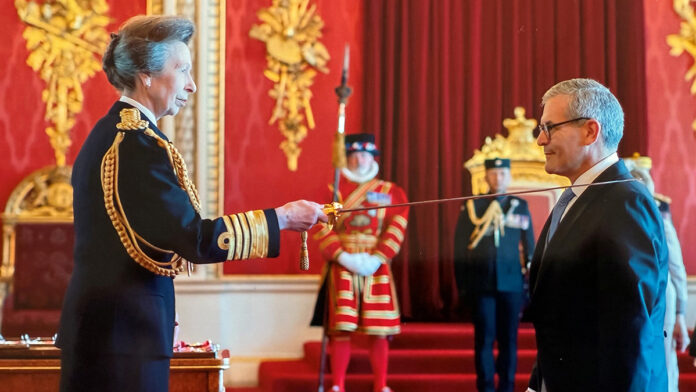
Sir Bradley Fried being knighted by Princess Anne


BY PROFESSOR PHILIP LANZKOWSKY 

Professor Philip Lanzkowsky

Once upon a time in Cape Town – not the bustling city we know today, but a modest port town where fishmongers blew horns in the street and chickens were sold fresh off the feather – there was a thriving little shtetl

It was a place where Jewish immigrants, mostly from Eastern Europe, built humble lives for themselves, with little more than a wagon, a work ethic, and a strong sense of community.

This was my Cape Town.

What makes this story more than just charming nostalgia is what came next: how the children and grandchildren of those immigrants rose from street vendors and butchers to become doctors, professors, psychiatrists, Nobel Prize winners, and even a knighted Governor of the Bank of England. The immigrants were determined that their children would receive a good Jewish and secular education – and it paid off!

Humble beginnings

In the Cape Town of my youth, most shopkeepers were Jewish and catered specifically to the community’s needs. There was a rhythm to the week, a build-up to Shabbat that you could hear, see, and smell. On Thursdays, Mr Schafer’s poultry shop bustled with customers selecting just the right chicken for Friday night dinner, feathers still warm. The discerning women of the shtetl would inspect each one like seasoned judges at an agricultural fair. If something seemed off – as once happened when my mother discovered a strange lump in a chicken – it was taken straight to the rabbi for inspection. (In that case, deemed kosher.)

Horse-drawn carts clattered along the streets, selling blocks of ice or fresh vegetables. One such vendor, Mr Pilowsky, made his rounds with a horse and cart; his son went on to become a professor of psychiatry in Australia. Then there was Mr Katz, a glazer turned baker, who hawked cookies and taygelach along the beach. He moved from being a hawker to the owner of a bakery with two stores. His son? A psychiatrist in the U.S.

My own father became a grocer. Although I had considered becoming a Rabbi, I ended up studying medicine. This profession allowed me to shine, and I have numerous academic and professional accolades behind my name – a far cry from helping my father with grocery deliveries in shtetl Cape Town!

The grandson of the butcher, Mr Fried, whose kosher meat fed the neighbourhood, became Governor of the Bank of England and was knighted by Princess Anne. When asked by a fellow banker if he came from a family of financiers, Bradley Fried quipped, “Not exactly. My father was a jeweller and my grandfather, a kosher butcher.”

In those days, the professionals – lawyers, doctors, bookkeepers – were all Jewish. Dr Berelowitz, one of the local physicians, made house calls with a doctor’s bag in one hand and a bag of change in the other – always ready to make exact change for a grateful patient.

What’s in a name?

Our shtetl was also home to a rich tradition of nicknames – mostly in Yiddish and sometimes hilariously literal. A particular Mr Katz, who was a rather large man, was known as “der grayser Katz” (‘the big Katz’). His son adopted the nickname as his surname – ‘Grayce’ – dropping ‘Katz’ entirely. I once had him as a tutor in medical school, and was surprised to realise the rather humble origins of the elegant-, English-sounding ‘Dr. Grayce’!

Then there was Mr Segal, a stocky carpenter with a limp, known (perhaps insensitively) as “der hinkerdiker” (‘the one who limps’). Despite working among tough dockyard labourers, he became the go-to man for complex problems: “Call the Jew,” they’d say, admiring his skill. His sons? Successful businessmen.

And who could forget “der blinder chazan,” Cantor Abraham Immerman? Despite being blind, he knew the entire Torah by heart and taught generations of boys their Bar Mitzvah portions. Or Mrs Uberstein, “der toyber” (‘the deaf one’), who would trumpet conversations through an ear horn that looked like it belonged in a Victorian drawing room.

Do you remember Cantor Immerman? Share your story about the famed Cantor with our readers. Send your recollection to editor@ctjc.co.za.

A community that rose

What’s truly astonishing is not just how vibrant this little Jewish world was, but how its legacy continues. Out of a community of just 20 000 Jews came an outsized number of professors, innovators, and thought leaders. Three were knighted. One won the Nobel Prize. Many became leaders in science, medicine, business, and academia around the world.

It’s a story of transformation, of rootedness and reinvention. It’s also a story full of charm, character, and characters.

Cape Town’s Jewish shtetl may be a memory now, but its legacy endures – in lecture halls, boardrooms, and hospital corridors across the globe. From fish horns to Nobel Prizes, it’s quite the journey. And I, for one, still hear the echo of Erev Shabbat in my heart. ●


  • For the current edition of the Cape Jewish Chronicle, click here.
  • Subscribe to the Cape Jewish Chronicle: R450/year, or R38/month via debit order. Simply email us at subscriptions@ctjc.co.za and click here for payment info.
  • The Cape Jewish Chronicle reaches over 6 000 readers monthly across print and digital platforms.
  • To book advertising space or discuss a custom package contact Adéle Gradner Mobile: 083 321 5222 | Office: 021 464 6736 | Email advertising@ctjc.co.za

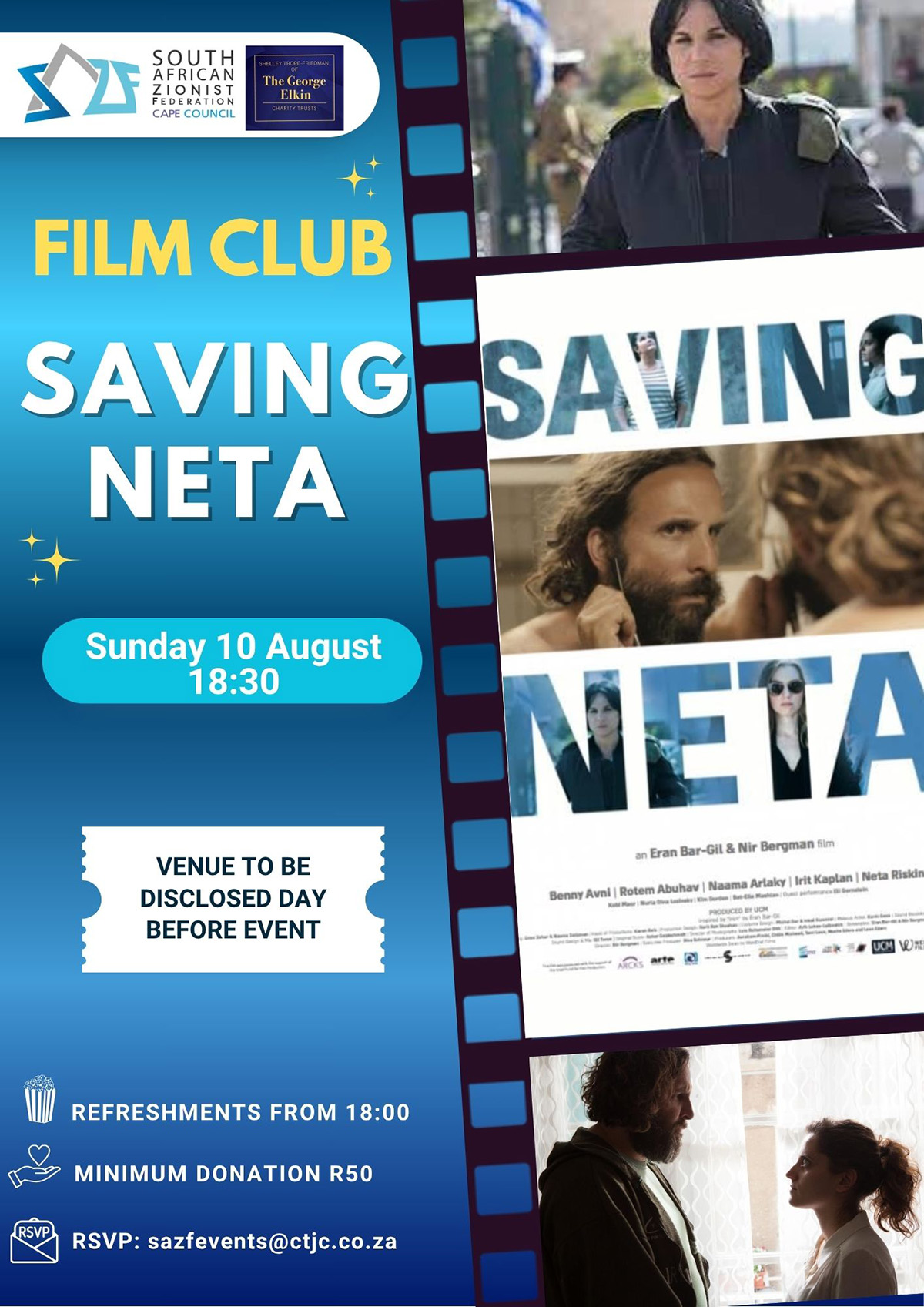
Film Club: Saving Neta

A still from Saving Neta (photography: Eitan Riklis)

10 August, at 18:30

Saving Neta (2016), directed by Nir Bergman, is an Israeli drama about four women whose lives intersect through a drifting stranger named Neta. Each faces a personal crisis, and their stories mirror and resolve each other’s questions, exploring femininity, parenthood, and human connection. Noted for its authentic female relationships, the film won the Audience Award at the Jerusalem Film Festival the year of its release.Watch the Saving Neta trailer.

SA Zionist Federation – Cape Council – Facebook | Twitter | Instagram


  • For the current edition of the Cape Jewish Chronicle, click here.
  • Subscribe to the Cape Jewish Chronicle: R450/year, or R38/month via debit order. Simply email us at subscriptions@ctjc.co.za and click here for payment info.
  • The Cape Jewish Chronicle reaches over 6 000 readers monthly across print and digital platforms.
  • To book advertising space or discuss a custom package contact Adéle Gradner Mobile: 083 321 5222 | Office: 021 464 6736 | Email advertising@ctjc.co.za

Interwoven threads: Polish and Jewish culture

Bread seen in a bakery – looks like a challah; it's called 'chalka' in Polish

“The extent of the impact of Jewish culture, cuisine and creativity in contemporary Polish culture cannot be overstated. It stands as a testament to the deep and lasting integration of Jewish life into the Polish cultural landscape.” says Jakub ‘Kuba’ Nowakowski, leader of the tour to Poland: ‘Echoes of (post) memory: A journey through Jewish Poland’ – organised by the Cape Town Holocaust & Genocide Centre, and currently on the go.

Kuba continues: “When the Polish Jews were murdered in the Holocaust their rich world was shattered, but not entirely lost, the crumbs remained, embedded deeply in the cultural DNA of contemporary Poland – in words we use without thinking, in tunes that we still play on the radio, in dishes passed down through generations and in the poetry we recite to our children.”

Listen to insights from Kuba


Words in Polish that are derived from Hebrew or Yiddish:


Children’s verses that were written by Jewish writers and musicians:


Poems and songs:


History of the Polish national soccer team – Jewish involvement in Polish sport was notable:

A classic Polish movie which had a Jewish director who was purged in the antisemitic purges in Poland in the 1960s. Jewish culture in Poland did not die because of the Holocaust – it lives on in so many ways in Polish culture:


The stereotyped view of Poland as the site of destruction, violence and antisemitism is true but it ignores the many positive stories that are also true:


Also read Journey through Jewish Poland: exploring memory and meaning


  • JULY 2025: Read the June 2025 Digital Edition in your browser as a Flipbook or a PDF.
  • SUBSCRIBE: Subscribe to the Cape Jewish Chronicle for just R450/year (or R38/month debit order) and you will remain connected. Simply email us at subscriptions@ctjc.co.za and click here for payment info.
  • ADVERTISE in the Cape Jewish Chronicle and on this website. Contact Lynette on 021 464 6736 or email advertising@ctjc.co.za.

Journey through Jewish Poland: exploring memory and meaning

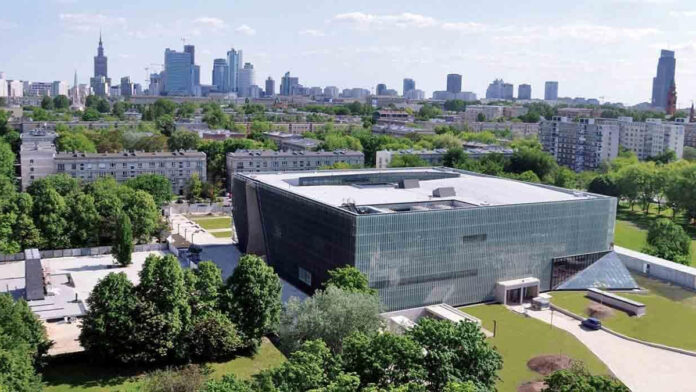
View of Warsaw and the POLIN Museum of the History of Polish Jews

The Cape Town Holocaust & Genocide Centre (CTHGC) has organised a tour to Poland, which kicks off this week. Called ‘Echoes of (post) memory: A journey through Jewish Poland’, the tour will tackle many of the uncomfortable and tragic elements of Polish Jewish history, while also looking at various Polish-Jewish issues in the contemporary Polish world. The Cape Jewish Chronicle will bring you news about the tour via our various channels.

Participants on the tour in Warsaw, July 2025

Tour participants speak about what they hope to achieve on the tour and what motivated them to join the tour. 

Cape Town’s Jos Hurwitz is travelling to Poland with her brother, Saul Gorin, who also lives here. Jos recently retired from many years in the education field, and has begun a new chapter in her life as a volunteer guide at the (CTHGC). Jos explains the importance of her participation in the CTHGC tour to Poland during late July 2025.

This journey is not only an educational opportunity – it is also a deeply personal one.

My father, Rachmiel Gorin (originally ‘Chweigon’), was born in Vilna (when it still fell under Poland) and came to Cape Town at the age of six with his mother Bassel (my Bobba Bassel) and four siblings. My grandfather Israel had already spent nine years working as a tailor in Claremont, saving to bring his family out of an increasingly precarious Europe. His foresight likely saved their lives.

Though my father seldom spoke of his childhood in Poland, he remained closely connected to the culture, food, and strong family values of the town called Ignalina and of Vilna. My brother Saul and I have chosen to take part in this tour to honour his memory, to walk the paths of our ancestors, and to deepen our understanding of where we come from.

This journey is both personal and communal. It is about honouring those who came before us – and ensuring that the stories, values, and lessons they carried are passed on with care and conviction. Holocaust education is more important than ever. It calls on us to remember, to bear witness, and to educate future generations with courage and compassion.


Capetonian Veronica Belling says, “My interest is historical and literary rather than family-orientated.

As a Jewish Studies librarian, researcher and teacher, I am passionate about Jewish languages – both Hebrew and Yiddish. My own family, like most South African Jews, came from Lithuania, just after the Boer War, in 1903. I have visited Lithuania twice. On the other hand with 3 million Jews in Poland – versus 220,000 in Lithuania – Poland was the heartland of Jewry – and Vilna, the capital of Lithuania, was once part of Poland! Moreover this tour is organised by the Cape Town Holocaust & Genocide Centre whose Director, Jakub Nowakowski, is himself a Pole. This is a first and I wanted to be a part of it!”


Why I am travelling to Poland (participant prefers not to be named)

I have never previously considered going there, however after meeting Kuba earlier this year in Cape Town, and hearing that he was arranging this trip, I felt confident that it would be a highly informative and sensitively managed week. I hope that it will allow me to try and and come to terms with the sorrow I feel as an older adult, regarding the severe losses to my parents’ and grandparents’ generation during the war. I don’t know the exact number of my Dutch and German relatives who perished at Auschwitz. I do know that it is more than 80 – and that’s on the Dutch side of the family – with the surnames Schuitevoerder and Kopuit. On the Spiegel and Frank side I am only recently trying to establish how many perished, as my late father did not speak about it enough for us to know.  Hence I recently know, through a German researcher, of one relative on my Dad’s side who died at Auschwitz and there will undoubtedly be more, since my Grandfather was one of 13 siblings, (their families yet to be traced).

Also read: Interwoven threads: Polish and Jewish culture


  • JULY 2025: Read the June 2025 Digital Edition in your browser as a Flipbook or a PDF.
  • SUBSCRIBE: Subscribe to the Cape Jewish Chronicle for just R450/year (or R38/month debit order) and you will remain connected. Simply email us at subscriptions@ctjc.co.za and click here for payment info.
  • ADVERTISE in the Cape Jewish Chronicle and on this website. Contact Lynette on 021 464 6736 or email advertising@ctjc.co.za.

SIGN UP TO RECEIVE THE CAPE JEWISH CHRONICLE