Home Blog Page 8

Auction of local art a resounding success

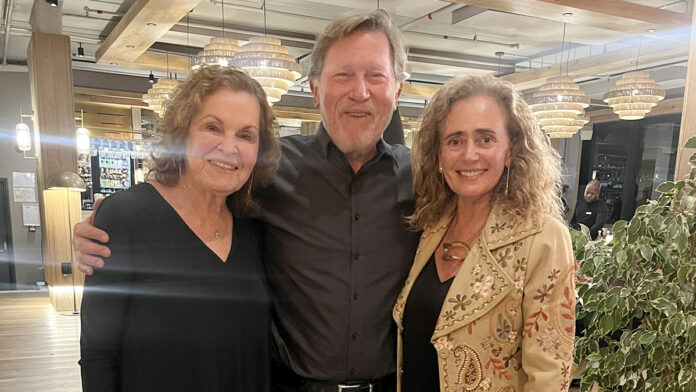
Nina Kovensky, Marco van Embden, Suzanne Ackerman
LISA TRUTER, Coordinator, SAFIM Art Collaborative

On Tuesday, 12 May, SAFIM Art Collaborative hosted their 9th Gala & Auction event at The Nines in Sea Point. Whilst outside the skies were cold and grey, inside there was a warm sense of community and generosity. 

SAFIM Art Collab was founded as the South African Friends of the Israel Museum in 2014. Since then, the organisation has grown significantly, and now supports local art education initiatives, alongside its work with the Israel Museum, Jerusalem. 

During his opening speech at the Gala, Co-Chairperson Marco van Embden highlighted that the Gala event is the cornerstone of the organisation’s fundraising efforts, with a target in surplus of R1 million to be raised on the night. Marco serves alongside Nina Kovensky and Suzanne Ackerman as National Co-Chairs of SAFIM Art Collab. The Johannesburg chapter is led by Della Berkowitz and Dori Weil. 

SAFIM Art Collaborative partnered with sponsors for the event, so that funds raised weren’t allocated to event costs, rather going directly to the various initiatives. Stonehage Fleming acted as the headline sponsor for the second year running – providing significant support to the event. Other generous sponsors included Cohesive Capital, the Kaplan Kushlik Foundation, and Blok. Partners supporting the event were Kove Collection (whose restaurant, The Nines, played host to the evening), ORMS (framing), and iToo Art Insure. Additionally, Strauss & Co are annual sponsors to SAFIM Art Collab, and provided significant support on the evening, ensuring that the auction was facilitated to the highest level. 

After guests spent time amongst the collection of 27 artworks, set out in an exhibition in the Station House foyer, everyone found their seats up at The Nines, and the auction began. Auctioneer Ariella Kuper opened the auction with a fantastic print by Sam Nhlengethwa, donated by the artist and Goodman Gallery. The print, depicting Steve ‘Kalamazoo’ Mokone kicked off the evening (pun intended ) – a fun work, especially in a FIFA World Cup year!

By the end of the evening, and having reaching a 100% sell-through rate, R1.52 million was raised through the sale of a significant collection of investment quality art. Auctioneer Ariella Kuper has long played an important role in SAFIM Art Collab’s fundraising auctions, which have now raised in excess of R9.5 million in total.

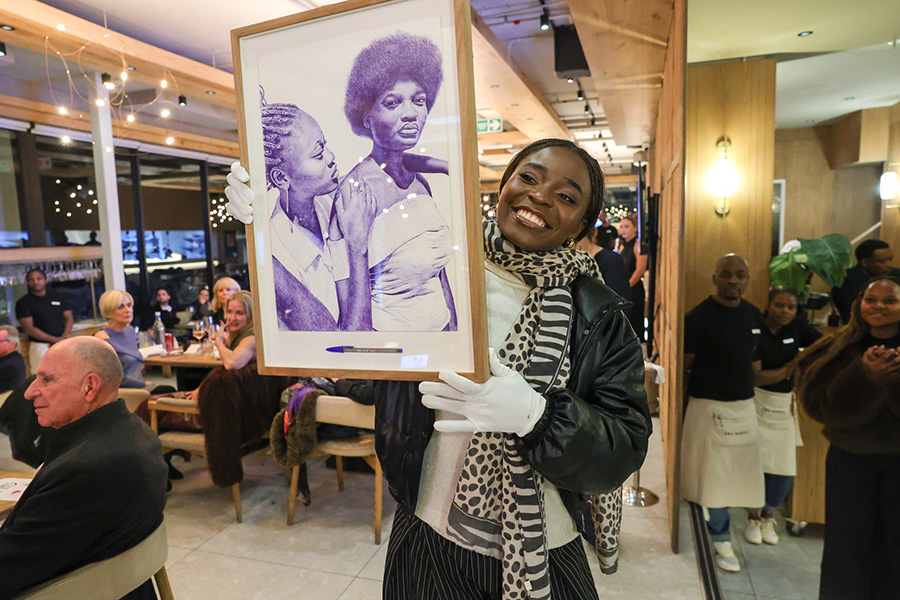
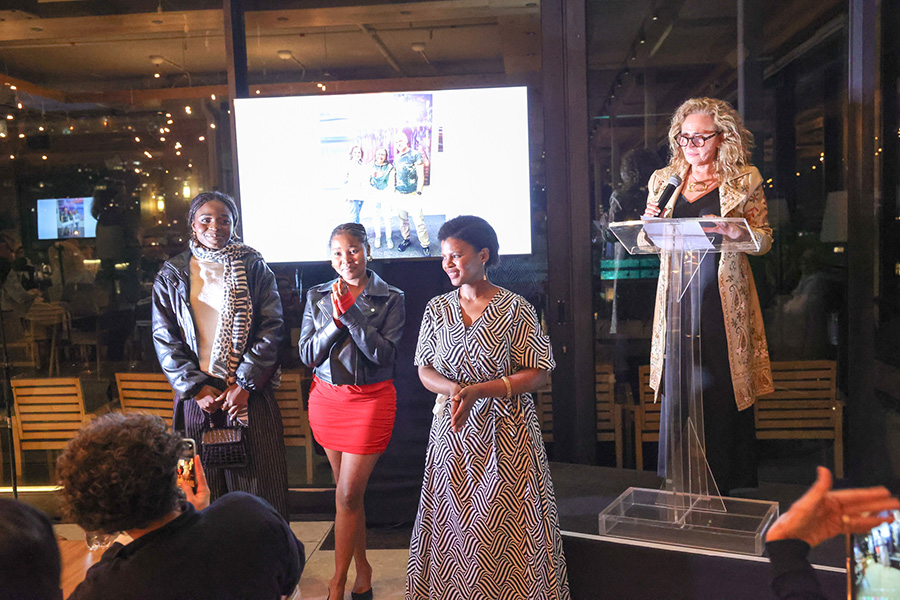
A highlight of the evening was undoubtedly the sale of three artworks by SAFIM Art Collab’s bursary recipients. As Suzanne Ackerman outlined for the audience, since 2023, the organisation has funded students at the Ruth Prowse School of Art studying towards their Fine Arts Diploma. Lona Ndzimande, Celine Ndzana and Zoli Ngxanga were present on the night as their works were each sold after a flurry of competitive bidding. Finally, their three works totalled R126 000 – a sum far greater than they would have imagined. These funds will be shared between the graduates themselves and SAFIM Art Collab’s future bursary recipients. Each of the graduates were overcome with emotion at this affirmation and celebration of their artistic talents. One can only hope that this will bolster and boost their journeys in pursuing their own artistic careers.

Alongside the bursary programme, funds raised will also support:

  • Curatorial Fellowships at a local institution: SAFIM Art Collab has sponsored 13 internships and fellowships at various institutions to date. Most recently, they have focused on year-long more senior opportunities for aspiring curators, placed at Norval Foundation. The partner institution for the 2026/27 iteration will be announced in due course. 
  • Creating Together at the Israel Museum: SAFIM Art Collab are the sole sponsors of this project which brings Ethiopian-Israeli children to the Israel Museum on a weekly basis to engage in play, to visit the Museum, and to learn, with art as a vehicle. The project’s focus is on cross-cultural learning and understanding. 
  • SAFIM Art Collab also offers a percentage of the auction proceeds back to the contributing artists. In this way, they are able to support and give back to these artists. In some instances, the artists earn more than they ordinarily would from their own sales. This auction earned in excess of R300 000 in commissions payable to artists.

Outside of the Gala event, SAFIM Art Collab runs regular membership programming throughout the year in both Cape Town and Johannesburg. This brings art-interested individuals to varied art and cultural events to meet curators, artists, authors and more, whilst supporting their fundraising efforts. 

During June, SAFIM will host a studio visit with artist Janice Codron in Cape Town.

For further information about SAFIM, contact Lisa Truter  – lisa@artcollab.co.za.

  • For the current edition of the Cape Jewish Chronicle, click here.
  • Subscribe to the Cape Jewish Chronicle: R450/year, or R38/month via debit order. Simply email us at subscriptions@ctjc.co.za and click here for payment info.
  • The Cape Jewish Chronicle reaches over 6 000 readers monthly across print and digital platforms.
  • To book advertising space or discuss a custom package contact Adéle Gradner Mobile: 083 321 5222 | Office: 021 464 6736 | Email advertising@ctjc.co.za

Look out for these books

From top left clockwise: Bonny Feldman, Alix Epstein, Maxine Boyd and Sheryl Schkolne

The Cape Jewish Chronicle has invited some of our readers who are book lovers to share their recommendations about books they have read – and loved! Please share your recommendations by contacting editor@ctjc.co.za.

Fiction

This Story Might Save Your Life by Tiffany Crum

Recommended by ALIX EPSTEIN. Alix is a teacher by day (at Herzlia Highlands Primary School); bookstagrammer by night; a lover of cats, sneakers, ice cream in any weather; and an avid reader in her spare time. See her Instagram page about books called @alix_in_wonderlnd

Best friends, Benny and Joy, who run a very popular and lucrative survival podcast, are thrown into their own tale of survival. One morning, Benny goes to Joy’s house, only to find their window smashed in, and Joy and her husband, Xander, are nowhere to be found. All signs point to Benny being the police’s main suspect; Benny must solve the mystery of his friend’s disappearance using the only clue that he has at his disposal: Joy’s unseen, incomplete memoir.

A genre-bending debut novel like no other. I devoured this cleverly written, exciting novel in one sitting. It is such a fascinating look at love and survival, and stopping at nothing to protect the people we love most. This book is written for the screen; it’s quick-witted, easy to read, and thrilling from beginning to end. If this is her debut, I am eagerly awaiting what comes next for this shiny new author.

The book is available on Kindle, as an audiobook, and is currently available online on Amazon.


Queen Esther by John Irving

Recommended by SHERYL SCHKOLNE, a voracious reader of fiction, a painter and ceramicist, and someone who has had the opportunity to travel widely. The travel provides inspiration for subjects to paint. See more about Sheryl’s art on her Instagram page: artbysheryl

The writer John Irving has written many books of which The World According to Garp and Cider House Rules are the most well-known. In 1999 he won an Academy Award for Best Adapted Screenplay for Cider House Rules

Queen Esther, published in 2025, deals with the recurring theme of avoiding enlistment during the Vietnam War, a theme that has appeared in previous novels and that Irving himself grappled with. The book highlights the importance of family and the influence of history and reading in determining your life path. The role of anti-Semitism in small-town America is discussed, as is the idea of surrogacy in the 1960s. 

After making Aliyah, Esther is often absent, yet her role in the development of the novel is crucial to understanding the complexity of human relationships.  From Germany to America and finally Israel, it is a novel on a grand scale.  Who is a Jew? How to navigate cultures different from your own, while remaining true to yourself. 

I found Queen Esther an absorbing and worthwhile choice of book.

The book is available for lending from the Jacob Gitlin Library or can be purchased on Loot. 


Non-Fiction

Kutchinsky’s Egg by Serena Kutchinsky

Recommended by MAXINE BOYD, a prolific reader, especially of Jewish non-fiction and history, as well as of Jewish historical novels, memoirs, and Holocaust literature. Maxine is a seasoned volunteer in Cape Town’s Jewish community.

Kutchinsky’s Egg is the story of an emigrant family from Russia who become one of the biggest jewellers in London. It tells of the family’s rise to high society, and how the author’s father became obsessed with making the world’s largest jewelled egg, a treasure to rival the Fabergé masterpieces. The obsession with the jewelled egg results in the loss of all his family’s money and the collapse of the House of Kutchinsky.  During this time, his marriage fails, and he becomes estranged from his daughters. After his death, his daughter decides to search for the jewelled egg that ruined his life and changed all their lives completely.  

This memoir – a true-life rags-to-riches story which takes one to numerous locations across the globe – is fascinating. I could not put it down as it was so riveting and took me into a world of jewellery, bad business decisions,  deceit, and family faribles that eventually split a family up.

The book is available for downloading on Kindle and for purchase on Takealot.


PODCAST

Dame Vera Stephanie (‘Steve’) Shirley on BBC Witness History: The Kindertransport children who fled the Nazis

EDITOR’S recommendation.

This tells the story of the flight of children from Germany to the UK in the late 1930s and provides insight into one person’s story. While the history of the Kindertransport is well-known, the story of an individual’s unique experience makes it far more meaningful. One would think that the fact that the child’s parents survived the War and were reunited with her would mean a happy ending, but it was difficult for the child to pick up the relationship with her parents after having been separated from them for
so long.

Listen to the podcast here.


  • For the current edition of the Cape Jewish Chronicle, click here.
  • Subscribe to the Cape Jewish Chronicle: R450/year, or R38/month via debit order. Simply email us at subscriptions@ctjc.co.za and click here for payment info.
  • The Cape Jewish Chronicle reaches over 6 000 readers monthly across print and digital platforms.
  • To book advertising space or discuss a custom package contact Adéle Gradner Mobile: 083 321 5222 | Office: 021 464 6736 | Email advertising@ctjc.co.za
Judge Dennis Davis: A life in law and music

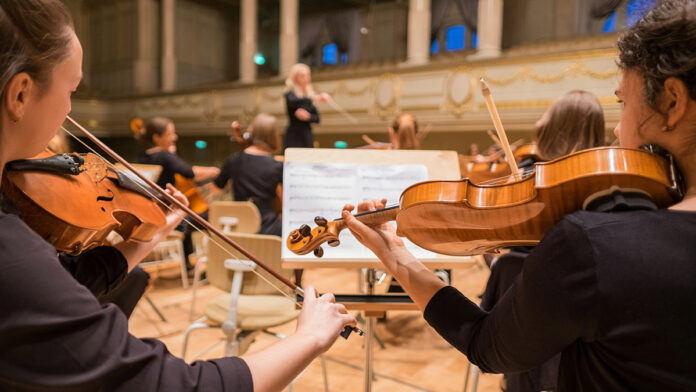
(credit: Manuel Nageli – Unsplash)
From courtroom to concert hall, a lifelong devotion finds its fullest expression
KAREN MILLER

There are public figures whose reputations arrive fully formed: robe, title, and the steady cadence of authority. Dennis Davis is one such figure: a High Court judge, formidable legal mind, law professor at many universities including UCT, Wits, Cambridge, Harvard and NYU, and a familiar television presence from Future Imperfect and You Be the Judge. Yet this well-known profile includes a more private, persistent devotion: a lifelong immersion in music that has now found institutional expression in his appointment as interim chair of the Cape Town Philharmonic Orchestra.

Beginnings in the living room

The roots of that devotion lie not in concert halls but in a family living room. Dennis’s father filled the house with the sound of great cantors, playing recordings of Richard Tucker and Jan Peerce singing Kol Nidrei. This was no incidental soundtrack. It was an early education in emotional expression, in the peculiar intensity of Jewish liturgical music, chazones, that binds history, longing, and faith into a single vocal line. Cape Town itself, in those years, provided formidable live examples: Koussevitsky at Schoonder Street and Philip Badash in Sea Point, voices that, as Davis recalls, sang with both magnitude and feeling.

A love affair begins

Like many enthusiasts, his early practical ambitions did not quite match his enthusiasm. He attempted the piano but describes himself, with characteristic bluntness, as “hopeless”. Music would not be something he produced so much as something he pursued, intellectually and emotionally.

A decisive moment came in 1967 at the Alhambra Theatre, where he encountered opera for the first time in a performance of Carmen. That same year, in a gesture both charming and revealing, he and schoolfriend, Gilad Stern, bought batons and took to conducting along with recordings. It was also the year he heard pianist Hans Richter-Haaser perform Beethoven’s Third and Fifth Piano Concertos at Cape Town City Hall. “I fell in love with classical music,” he recalls, a statement that, in its simplicity, masks a lifetime’s accumulation of listening, learning, and reflection.

The pattern was set. Records borrowed from the municipal library, Sunday evening concerts, and an ever-expanding auditory world. Even singing, despite his professed lack of talent, found its way in: he remains proud to have sung in the choir for Beethoven’s Ninth Symphony, that great choral affirmation.

Along the way, he has heard many of the greats: Daniel Barenboim, Arthur Rubinstein, Pinchas Zuckerman, Itzhak Perlman, and conductors from Solti to Karajan to Rattle. These are not merely names to be dropped but markers of a life attentively lived in music.

Tradition, music, and continuity

Yet it is impossible to disentangle Dennis’s musical life from his Jewish one. From Grade 4 at Herzlia, he learned davening under the late Cantor Immerman. He later ran student services at the Old Shul in Gardens and assisted Rabbi Steinhorn during the High Holy Days in Sea Point. To this day, he continues to play a role in the Egalitarian Shul’s High Holy Day services. The continuity is striking: from childhood liturgy to adult responsibility, from inherited tradition to chosen participation.

Music, for Dennis, is not merely aesthetic. It is reflective. Driving to work, he plays chazones in the car, using it as a space to contemplate “the joys and sorrows of Jewish life and history”. This is not background noise. It is a form of thinking.

Lockdown and a global classroom

His engagement has, in recent years, taken on a more public dimension through Lockdown University, the global online initiative founded by Wendy Fisher during the Covid-19 pandemic. Initially contributing lectures on politics and law, Dennis soon extended his repertoire to music. Inspired by performances he had attended in the United States, most notably at Carnegie Hall, where Leonard Slatkin presented Beethoven’s Ninth with an explanatory first half. This has inspired him to adopt a similar format. 

The result has been remarkably prolific: over 130 lectures since 2020, including detailed explorations of Mahler’s symphonies, jazz, and the broader classical canon. 

His study at home, he admits is a dense landscape of CDs, as he compares interpretations and refines his understanding. There is an infectious enthusiasm in this work, though he admits to finding the scale of his audience, now numbering in the thousands worldwide, somewhat daunting. The intimacy of early Zoom sessions has given way to a more impersonal, if far-reaching, exchange.

Now, as he approaches his 75th birthday, Davis has chosen a fitting gift for himself. He will travel with his wife, Claudette, to Berlin to hear the Berlin Philharmonic under the baton of the 98-year-old Herbert Blomstedt, conducting Bruckner’s 7th Symphony, one of Davis’s particular favourites. It is hard to imagine a more appropriate celebration: a convergence of longevity, mastery, and emotional depth.

In a world inclined to compartmentalise, to separate the rational from the artistic, the judicial from the lyrical, Dennis Davis offers a more integrated model. The law may be his profession, but music, unmistakably, is a profound source of joy and inspiration.  He has served this muse in many ways and he does so now in public contribution to the Cape Town Philharmonic Orchestra. 


  • For the current edition of the Cape Jewish Chronicle, click here.
  • Subscribe to the Cape Jewish Chronicle: R450/year, or R38/month via debit order. Simply email us at subscriptions@ctjc.co.za and click here for payment info.
  • The Cape Jewish Chronicle reaches over 6 000 readers monthly across print and digital platforms.
  • To book advertising space or discuss a custom package contact Adéle Gradner Mobile: 083 321 5222 | Office: 021 464 6736 | Email advertising@ctjc.co.za

A Flotilla and a Minister

Julian Resnick
Julian Resnick

Many years ago, a friend and I were approached by a senior team member of Makom, an innovative education initiative within the Jewish Agency for Israel to put together a unique day for a group of people from the Jewish Federations of North America, people with a strong commitment to Israel. These were people who really cared about Israel, worked on behalf of Israel, raised money for Israel, lobbied for Israel.

They had all been to Israel many times before, had visited all the major sites, and beyond, but this was to be a special day, one I had never imagined putting together before this request came my way, and one never repeated since. The idea was to show them the dark underbelly of Tel Aviv: the things we are not proud of, that have not worked in Israeli society; the folks who got left behind; the underclass. We put together a day, which, I have to admit, I found incredibly challenging to experience, as did the group we took around for the day. This was not the Israel of the Start Up Nation; of those who give their everything in the service of the State; of beautiful works of art; of nobility of spirit; of self-sacrifice for a cause larger than oneself.

This was poverty, illegal immigrants (refugees) who had been smuggled in via the Sinai Peninsula, homeless people, drug addicts and prostitutes; a soup kitchen; a kindergarten adjoining a brothel. 

Two moments from that day have stayed with me over the years. One, when an illegal immigrant passed out and I began to call Magen David Adom for help, only to be stopped by another refugee, who told me not to, as the moment an intervention like this happened, the person who had passed out would be in the system and easier to deport. (Deportation meant in effect being sent back to a war zone, to a harsh refugee camp in Southern Sudan or Eritrea, possibly to be sentenced as an opponent of the regime and, therefore, likely not to reach old age.)

The second moment which has stayed with me was when we sat down to have lunch in the soup kitchen with the local folks. To my great embarrassment, I could not bring myself to eat the food. Something very deeply embedded in me made this an impossibility for me.

The discussion we had afterwards came back to me recently. We talked about what one does when the country one loves, that one is committed to, that one would fight for, possibly even die for, has these terrible blemishes, awful imperfections. It came back to me as I watched our Minister of Internal Security, Itamar Ben Gvir, behaving in a way that recalled, in my very South African memory bank, the way I was treated in Caledon Square after having been arrested by the South African Police way back in 1974. And, there were worse associations floating through my mind as well, from before the year I was born – and Jews were on the receiving end in those associations. As we say in Hebrew: המבין יבין

What are we to do when a member of the Government of Israel behaves in the way Itamar Ben Gvir behaved towards the members of the Gaza-bound flotilla on 20 May? For me, the answer is clear: We have to condemn him in the strongest possible terms, as Jews who believe that we have a heritage to be proud of which includes an ethos, a value system, which we never toss aside to wreak revenge. As Jews who care for the safety and security of our People, throughout the world. As Jews who care about the defence of our homeland, of Israel.

We have to say, in unequivocal terms, “Itamar Ben Gvir, you are a disgrace to the Jewish People, a disgrace to the State of Israel. Your behaviour puts our People at risk, both in Israel and in Cape Town. Your behaviour diminishes the careful and totally appropriate way our soldiers of the IDF conducted this interception of the flotilla.”

If you really care about Israel and the Jewish People, when something like this happens, speak up, as proud Zionists and Jews. Do not fall into the trap of ‘closing ranks’. Speaking up is what the Jewish People and Israel need right now. 

Itamar Ben Gvir, you disgrace both the memory of our martyrs, and you put our children at risk. Shame on you.


  • For the current edition of the Cape Jewish Chronicle, click here.
  • Subscribe to the Cape Jewish Chronicle: R450/year, or R38/month via debit order. Simply email us at subscriptions@ctjc.co.za and click here for payment info.
  • The Cape Jewish Chronicle reaches over 6 000 readers monthly across print and digital platforms.
  • To book advertising space or discuss a custom package contact Adéle Gradner Mobile: 083 321 5222 | Office: 021 464 6736 | Email advertising@ctjc.co.za

Daddy Ochberg – as remembered by Molly Cohen z”l

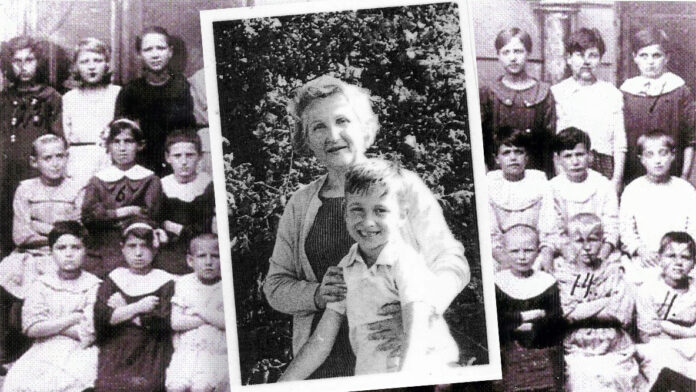
Molly as a grandmother (and Ochberg Orphans – background)

Chronicle reader Charlotte Cohen read the article about the ‘Ochberg Orphans’ in our May edition (read it here!), and shared the recollections of her late mother-in-law, Molly Cohen, who was the last surviving Ochberg Orphan in Cape Town. She passed away in 2013 – 9 days before her 100th birthday. 

When Molly Cohen recalled her childhood, one figure stood above all others – Isaac Ochberg, the Cape Town businessman and humanitarian who rescued nearly 200 Jewish orphans from the devastation of post-World War I Eastern Europe.

To the children he saved, he was simply “Daddy Ochberg”.

Born in Ukraine in 1913, Molly – then Molly Schapera – was only seven years old when she arrived in Cape Town in 1921 aboard a ship carrying the children who would later become known as the “Ochberg Orphans”. Her memories of Europe were fragmentary and painful. She remembered being “shunted around”, living with different families and knowing nothing but instability and loss. She barely remembered her parents and only later learned she had three brothers and two sisters. 

Then came the journey to South Africa.

Molly remembered being placed on a ship with many other children, the voyage delayed after one child contracted mumps. But what stayed with her most vividly was the man who had made their rescue possible.

“’Daddy Ochberg’ – that’s what we called him,” she said. “That’s what he was to us.” She recalled him translating Yiddish letters into English for the children and reading them aloud. To Molly, he was always present, always caring. She described him as “a man of exceptional kindness and great courage”. 

Ochberg himself had emigrated from Ukraine to South Africa as a teenager in the 1890s and later established himself as one of Cape Town’s leading entrepreneurs through timber, shipping and property ventures. Yet business success was only part of his legacy. According to his daughter, Bertha Epstein, he believed that success created a moral obligation to help those less fortunate. 

That conviction would define one of the great humanitarian missions in South African Jewish history.

As pogroms, famine and disease ravaged Eastern Europe after World War I, Ochberg became president of the Cape Jewish Orphanage. In 1921, he personally travelled through devastated parts of Poland, Galicia and Ukraine to rescue Jewish children left orphaned and destitute. He moved from village to village collecting children who were starving, traumatised and often homeless. Ultimately, 167 children reached South Africa under his care after an arduous journey through Europe and England. 

For Molly, arriving in Cape Town marked the beginning of a completely different life.

She grew up at the Jewish Orphanage in Cape Town, predecessor to Oranjia. Far from remembering deprivation, she spoke warmly of a loving and deeply involved Jewish community. The children attended school in Buitenkant Street, went to cheder after classes and spent weekends playing in the grounds of the Home. On Sundays, members of the community would visit constantly, bringing warmth, companionship and support.

“We were adopted by the whole Cape Town community,” Molly said years later. “We were taken into their homes – and more importantly, into their hearts.” 

Although she later experienced loneliness as a teenager, aware that she had no close family to rely on, Molly never forgot the kindness that surrounded her formative years in South Africa. She described those early years as happy ones, shaped by generosity, stability and care.

Molly learned later on that two of her brothers managed to get to Palestine, but she did not have a strong relationship with them, living apart from them in her formative years.

Looking back on her life, Molly believed the rescued children had been given something extraordinary – not only safety, but the chance to build families and futures of their own. Through Isaac Ochberg’s courage and compassion, generations were born who otherwise may never have existed.


  • For the current edition of the Cape Jewish Chronicle, click here.
  • Subscribe to the Cape Jewish Chronicle: R450/year, or R38/month via debit order. Simply email us at subscriptions@ctjc.co.za and click here for payment info.
  • The Cape Jewish Chronicle reaches over 6 000 readers monthly across print and digital platforms.
  • To book advertising space or discuss a custom package contact Adéle Gradner Mobile: 083 321 5222 | Office: 021 464 6736 | Email advertising@ctjc.co.za
Things happen for a reason – be grateful for what we have

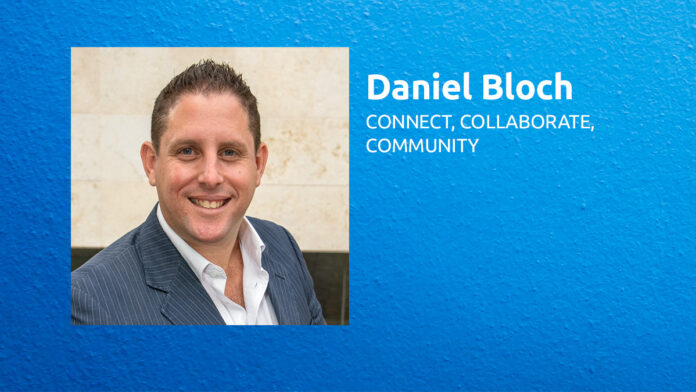
Daniel Bloch

The past month has been an extremely emotional rollercoaster for me personally. It has certainly made me reflect on what is truly important in life and just how fortunate I am to have the life I do.

By sharing some of these personal experiences, perhaps it may also encourage others to reassess their own lives and recognise what they should be grateful for.

My son and I were recently involved in a serious car accident. While we both walked away with little more than a scratch and a bruise, my car was not as fortunate – nor were the other two vehicles involved (the drivers and passengers were also fine). Without going into the details, the front of my car was destroyed, giving some indication of just how fast the other driver was travelling when he hit us side-on. Fortunately – and some may say miraculously – the hand of Hashem intervened. At the very last moment, the other driver swerved slightly, avoiding a direct impact into my door and instead taking out the front of the vehicle. Every time I rewatch the footage and relive that moment, I thank Hashem that my son and I were able to walk away unscathed. 

In the aftermath, one of my biggest challenges was simply trying to find a replacement vehicle – and even that reminded me how fortunate I am to be able to do so.

Following the devastating storms in Cape Town, many homes suffered severe damage and thousands of people were affected in different ways. In my case, I have a small roof leak that will cost a few pennies to repair, and a protea tree was uprooted. We all face different problems, but mine are manageable and fixable – nothing compared to what many fellow Capetonians are currently experiencing. Many people simply do not have the means to repair their homes or replace what was lost. Again, I am reminded how grateful I should be that my challenges are relatively minor.

The same perspective applies when comparing what Jewish communities around the world are experiencing to our reality here in the Western Cape.

During Yom Yerushalayim, together with our Chairperson, Simone Sulcas, and my colleague Josh Friedman, we spent Shabbos with the Jewish community in Hermanus. On Friday evening, we addressed more than 50 community members, discussing the work of the Board, addressing concerns, sharing insights from conversations with Jewish communities abroad, and ultimately reinforcing an important message: that Jewish life in the Western Cape remains, for the most part, safe, secure, and thriving. (Read the Hermanus article elsewhere in this edition of the Chronicle.)

While many Jewish communities around the world are increasingly forced to hide their identities or fear openly expressing their Judaism, here in the Western Cape we continue to live proudly and unapologetically as Jews. That is not to say there are no challenges or uncomfortable spaces, and we must always remain vigilant. However, the reality is that we are not removing mezuzot from our homes, hiding our kippot, or retreating from public life.

We should be thankful for the work our communal organisations do – to those who protect our way of life, those who look after our aged, those who educate our young, and those who celebrate our Judaism with pride. We should never take for granted the fact that, as Jews and as South Africans, our rights are protected.

Things happen for a reason. I do not know why my son and I were involved in that accident, nor why Hashem chose to spare us from what could have been a devastating tragedy. What I do know is this: I am grateful to be alive. Grateful for my family and friends. Grateful for the life I have. And grateful that I have the privilege of living openly as a proud Jew and representing our incredible community as proudly South African Jews.

Cape SA Jewish Board of Deputies | http://www.capesajbd.org | Instagram | Facebook


  • For the current edition of the Cape Jewish Chronicle, click here.
  • Subscribe to the Cape Jewish Chronicle: R450/year, or R38/month via debit order. Simply email us at subscriptions@ctjc.co.za and click here for payment info.
  • The Cape Jewish Chronicle reaches over 6 000 readers monthly across print and digital platforms.
  • To book advertising space or discuss a custom package contact Adéle Gradner Mobile: 083 321 5222 | Office: 021 464 6736 | Email advertising@ctjc.co.za
May 2026

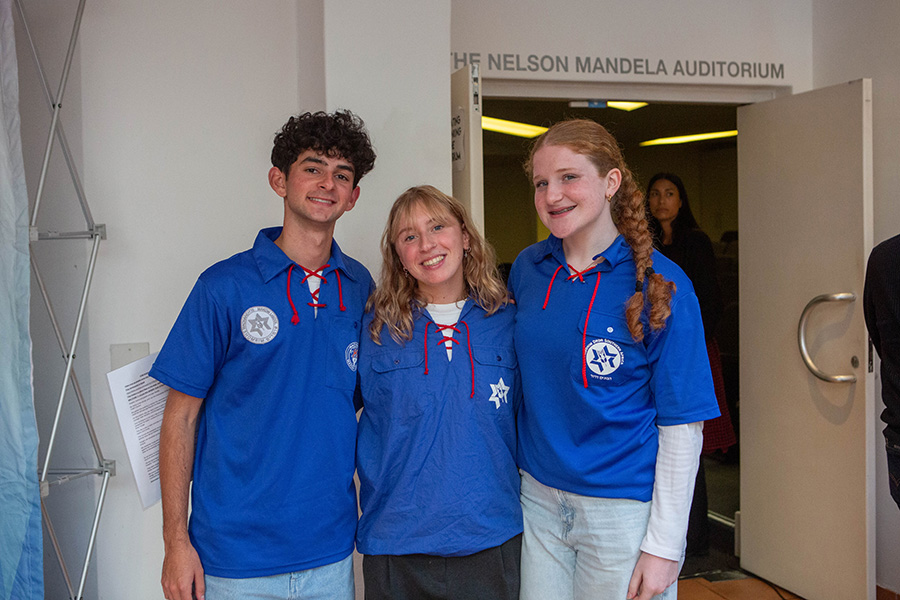
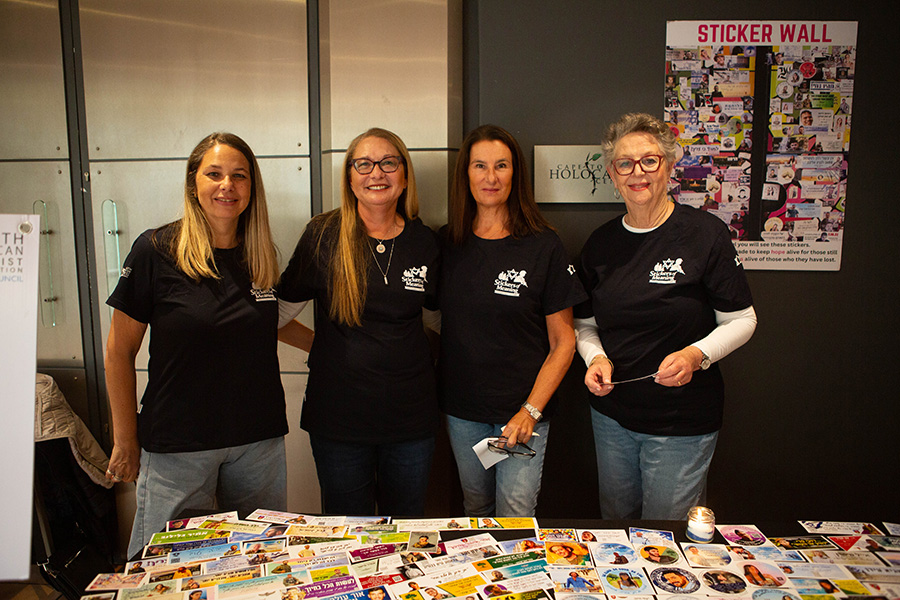
April was a month of both celebration and commemoration. With both Yom Hashoah and Yom Hazikaron falling during the month, as well as Yom Ha’atzmaut, our community was kept busy at a number of events.

A number of articles relating to arts and culture are included this month. From an interesting historical footnote about South Africa’s first participation in the Venice Biennale, to the legacy of Wolf Kibel, a peek into a family art collection, and the ever-popular Aviva Pelham returning to the stage, there’s plenty to enjoy.

It’s becoming rare to hear a reasoned, well thought-through argument about the Middle East conflict and its impact on Jews throughout the world. That’s why the opinion piece penned by Mzoxolo Mpolase is such a breath of fresh air. Take a look at it here.


  • For the current edition of the Cape Jewish Chronicle, click here.
  • Subscribe to the Cape Jewish Chronicle: R450/year, or R38/month via debit order. Simply email us at subscriptions@ctjc.co.za and click here for payment info.
  • The Cape Jewish Chronicle reaches over 6 000 readers monthly across print and digital platforms.
  • To book advertising space or discuss a custom package contact Adéle Gradner Mobile: 083 321 5222 | Office: 021 464 6736 | Email advertising@ctjc.co.za

A debut under pressure – South Africa at the 1950 Venice Biennale

Jay van den Berg on an exhibition walkabout

In 1950, South Africa stepped onto one of the world’s most prestigious cultural stages – the Venice Biennale. It was a moment that might have signalled confidence and cohesion. Instead, it revealed a country deeply divided about art, identity, and its place in the modern world.

South Africa’s participation did not emerge from a clear national strategy. Rather, it was the result of a confluence of ambition, improvisation, and pressure from artists eager to engage with international modernism. Cape Town sculptor Lippy Lipshitz was one of these artists.

The road to Venice began in 1949, when a group of South African artists – including Lipshitz, Irma Stern, and Walter Battiss – exhibited in Turin and Rome under the auspices of the International Art Club. These exhibitions helped secure an invitation to the Biennale, marking South Africa’s formal entry into an international art world still rebuilding after World War II.

Yet from the outset, the process was fraught. A selection committee appointed by C. R. Swart, then Minister of Education, Arts and Science, chose a group of artists that leaned toward modernist experimentation rather than conservative tradition. Alongside Lipshitz were figures such as Cecil Higgs and Jean Welz – artists whose work reflected European influences and a desire to push beyond academic norms.

This choice sparked immediate backlash. The Afrikaans press, most notably Die Burger, criticised the selection in terms that blurred aesthetic judgement with cultural politics. What might have been a debate about artistic style quickly became something more charged – a question of who had the authority to represent South Africa, and what that representation should look like.

Jay van den Berg, Associate Curator at the South African Jewish Museum, refers to a University of Cape Town doctoral thesis, in which researcher Annchen Bronkowski wrote, “The Biennale exposed fault lines that were already there. It wasn’t just about whether people liked modern art or not – it was about identity, power, and who got to define culture in South Africa.”

Jay notes that the controversy cannot be separated from the broader political climate of the time. “You’re looking at a country in the early years of apartheid, where ideas of nationalism were becoming increasingly rigid. Modernist art – often influenced by Europe, often experimental – didn’t fit neatly into that framework.”

As criticism mounted, official support for the exhibition wavered. Unlike later decades, when participation in international exhibitions would be more systematically organised, the 1950 pavilion was marked by a striking lack of institutional backing. In the end, South Africa’s presence in Venice was made possible not by the state, but by a private donor who stepped in to fund the exhibition.

“That detail is incredibly telling,” Jay adds. “It shows just how precarious the whole project was. Without private support, South Africa might not have been there at all.”

Within the pavilion itself, the tensions continued. The exhibition did not present a unified vision of ‘South African art’. Instead, it brought together competing approaches – conservative and modernist, local and international – without resolving the contradictions between them. Lipshitz’s work, rooted in both European modernism and African material traditions, exemplified this complexity.

Today, visitors to the South African Jewish Museum can see some of the works Lipshitz exhibited internationally, including Tree of Life (Umuthi Wentilo) (1950). Carved in yellowwood, the sculpture reflects a synthesis of influences that defied easy categorisation – much like the country he represented.

Looking back, the 1950 Venice Biennale stands less as a triumphant debut than as a revealing one. It marked South Africa’s entry into the global art conversation, but did so in a way that exposed deep internal divisions.

“There’s a tendency to look for neat narratives in history,” Jay reflects. “But this moment wasn’t neat. It was messy, contested, unresolved – and that’s precisely why it matters.”

In that sense, South Africa’s first appearance in Venice was not just about art. It was about a nation grappling with itself – its identity, its values, and its future – on an international stage where those questions could no longer be avoided.

EDITOR’S NOTE: 
I have attended two walkabouts of the Wolf Kibel Lippy Lipshitz, Palm Studios exhibition currently on at the SA Jewish Museum. Jay van den Berg presents an insightful, knowledgeable, and entertaining view of the two artists and their work. I highly recommend that you join one of the remaining walkabout sessions: Wednesday, 27 May at 10am; and Wednesday, 17 June at 10am.


  • For the current edition of the Cape Jewish Chronicle, click here.
  • Subscribe to the Cape Jewish Chronicle: R450/year, or R38/month via debit order. Simply email us at subscriptions@ctjc.co.za and click here for payment info.
  • The Cape Jewish Chronicle reaches over 6 000 readers monthly across print and digital platforms.
  • To book advertising space or discuss a custom package contact Adéle Gradner Mobile: 083 321 5222 | Office: 021 464 6736 | Email advertising@ctjc.co.za

Li and Stan Boiskin: a lifetime of art

Stan and Li Boiskin

BY KAREN MILLER

The story of Stan and Li Boiskin is a story of a life shared through not only community, and a deep, instinctive engagement with the world around them, but also through beautiful art that lined the walls of their family home.  

For decades, the couple were woven into Cape Town’s Jewish and cross-community cultural and philanthropic fabric, their influence extending far beyond the walls on which their paintings once hung.

Married in 1962, Stan and Li spent 64 years together, until Li died in August 2025, most of them in their Sea Point home, where they lived for 57 years. It is a large, 13-room house, gradually filled with artworks that became a visual part of their daily life. By the time their collection came to auction in March this year, those walls had already begun to empty, with only a small group of paintings that their children requested.

When the collection was assembled at the Strauss & Co gallery in Woodstock ahead of the late March sale, it offered a rare opportunity to see the works together, outside the intimacy of a private home. Hung with space and careful attention, each painting stood on its own. For Stan, however, they remained bound to memory and daily living. Seeing them in this new setting brought both pride and a sense of loss:
“My main feeling is one of regret that they’re off my walls.”  He had approached the decision with characteristic pragmatism, mindful that his children, living overseas, would otherwise have had to manage the dispersal of the collection.

The auction included 34 works, alongside a number that had already been sold directly. Together, they reflected a deeply personal way of collecting, one shaped not by market considerations but by instinct, historical interest, and emotional response. Stan had begun buying art in earnest between 1995 and 2015, though his first purchase dated back much earlier: a painting by David Allen, bought at a Hermanus market, which sparked a lasting interest. From there, acquisitions followed through auction houses such as Welz and Strauss, as well as more personal encounters, including purchasing a work directly at the flat of local artist, Stanley Hermans.

Despite the presence of major South African modernists – Irma Stern, Maggie Laubser, George Pemba, Pierneef, Cecil Skotnes, Maude Sumner, and Pranas Domsaitis – Stan had always been clear about their motivation. “I didn’t see art as investment but to enjoy the works on the walls.” Each work was chosen for what it conveyed, rather than what it might yield.

The prominence of Irma Stern within the collection proved particularly resonant at the time of the sale. Renewed attention had been focused on her work, with her collection temporarily housed at the Norval Foundation and a series of exhibitions taking place there while her historic home undergoes refurbishment. 

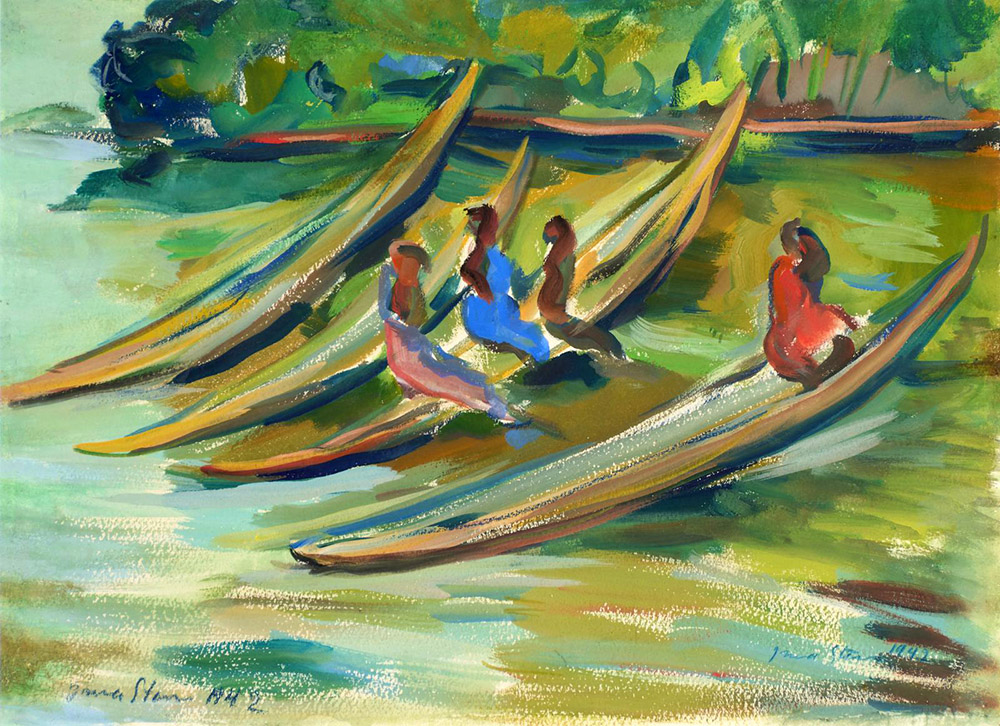
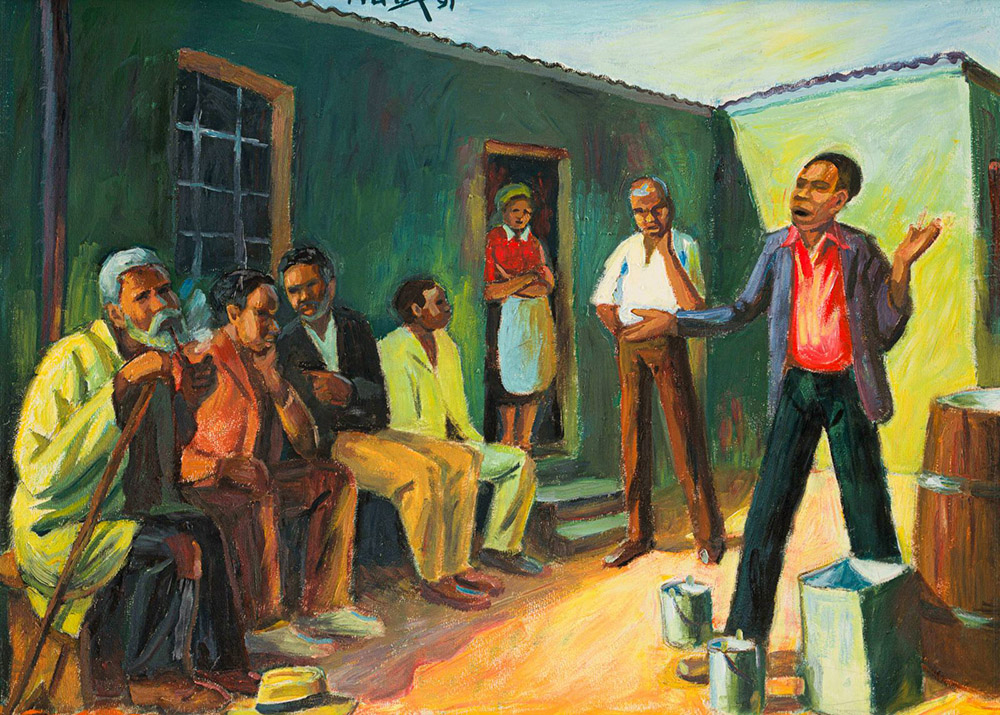
If Stan had been the driving force behind the acquisitions, Li’s presence had been equally vital. She lived with the works, responded to them, and occasionally challenged them, sometimes insisting that a painting be returned. Their shared favourites, including Stern’s works, especially the gouache, Canoes on the Congo River and George Pemba’s Sangoma reflected a mutual sensibility grounded in both aesthetic appreciation and human narrative.

Yet the Boiskins’ legacy extended well beyond their collection. Their patronage had always been closely tied to their values: a commitment to education, remembrance, and social cohesion. They supported Holocaust education initiatives, interfaith programmes, and projects aimed at fostering understanding through historical awareness, alongside broader community welfare efforts. In their lives, art, education, and social responsibility were never separate pursuits, but part of a larger, interconnected whole.

As the collection disperses, it carries with it the imprint of a shared life. These were not simply paintings, but markers of a long partnership, of choices made together, of conversations held in front of canvases, and of a home shaped by what they loved.


  • For the current edition of the Cape Jewish Chronicle, click here.
  • Subscribe to the Cape Jewish Chronicle: R450/year, or R38/month via debit order. Simply email us at subscriptions@ctjc.co.za and click here for payment info.
  • The Cape Jewish Chronicle reaches over 6 000 readers monthly across print and digital platforms.
  • To book advertising space or discuss a custom package contact Adéle Gradner Mobile: 083 321 5222 | Office: 021 464 6736 | Email advertising@ctjc.co.za

From remembrance to celebration: a community united

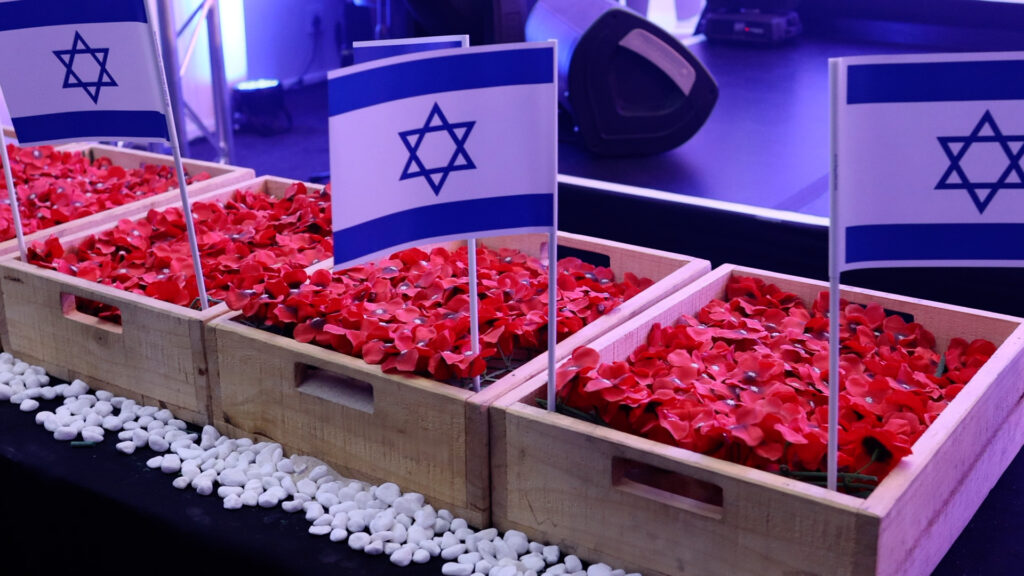
There is a profound and meaningful synergy in the way we move from remembrance to celebration: from honouring the Holocaust, to acknowledging the sacrifice of our dear soldiers who fell in defence of the State of Israel, and the victims of terror,
and finally to celebrating the joy of our ancestorial homeland, Israel.

We journey from a history of vulnerability and persecution, to recognising the courage and sacrifice that has enabled us to defend ourselves, and ultimately to celebrating the realisation of that journey, our own sovereign state in our ancestral homeland, Israel.

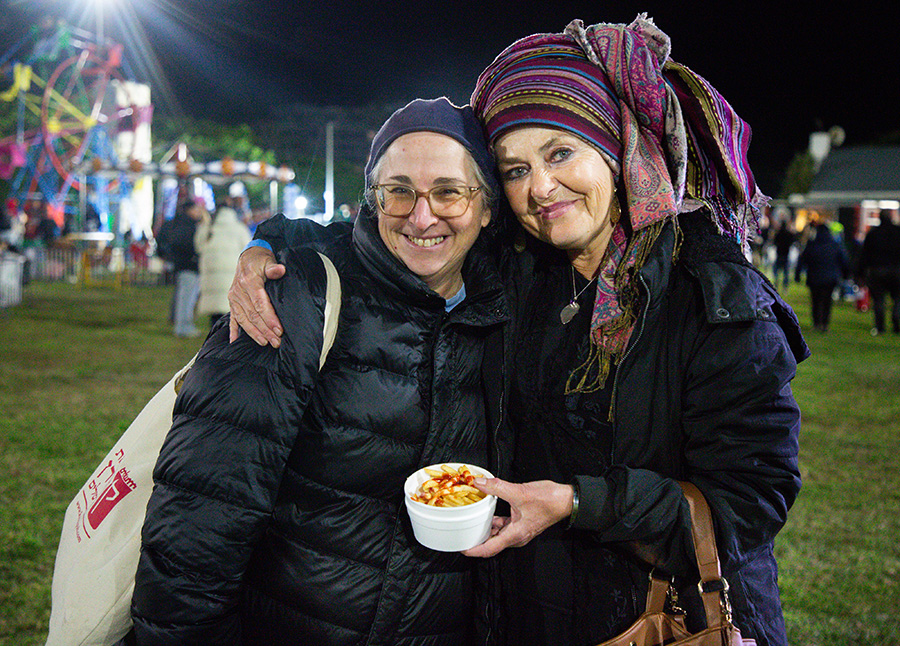
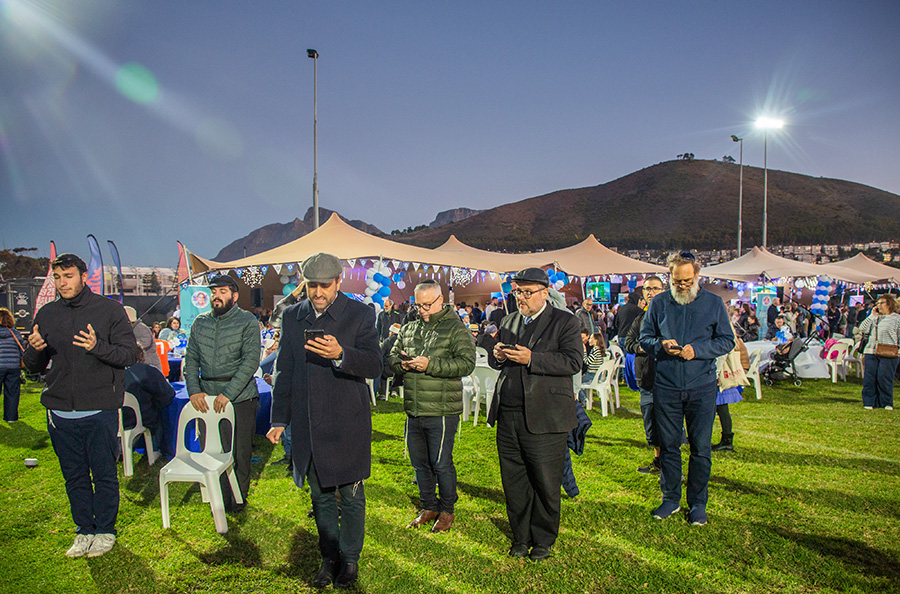
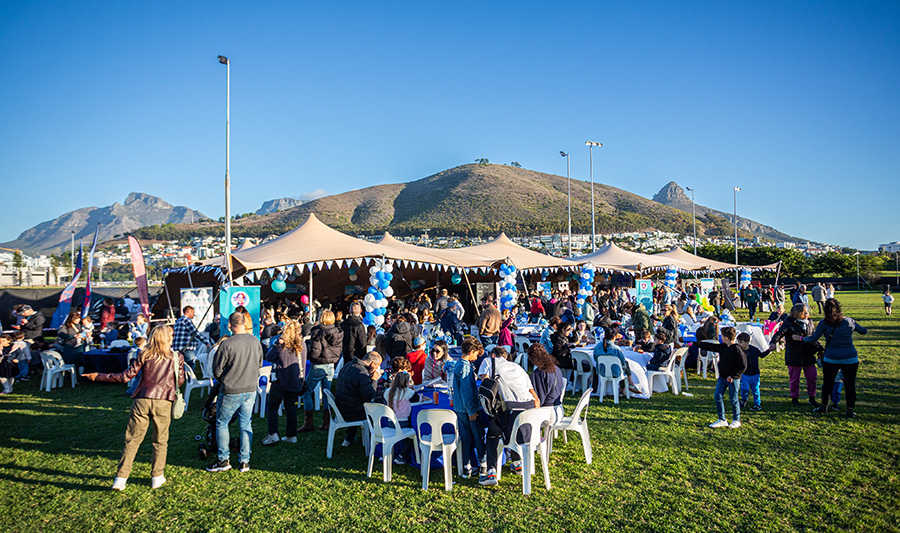
Cape Town’s Yom Ha’Atzmaut celebration was an electric, vibrant, and joy-filled celebration. Children enjoyed a wide range of activities, from rock wall climbing and gyro rides to jumping castles. The atmosphere was enriched by kosher food stalls offering everything from Spur burgers, pizza, chicken bites, and falafel, alongside vendors with a variety of goods. DJs kept the energy high throughout the evening, and the Rock of Ages concert delivered two outstanding performances that were warmly received by all.

It was truly a night to remember.

We would like to extend our sincere thanks to the community for coming out in such strong numbers to celebrate Israel’s birthday. Your presence reflects the depth of your commitment to Jewish identity and your connection to our national homeland. More than just a celebration, the event created a meaningful space for people of all ages and backgrounds to come together, reconnect, and share in a collective sense of pride and belonging. Families, friends, and newcomers alike were able to engage with one another, strengthening existing bonds while forming new connections. The atmosphere of unity, joy, and shared purpose was truly inspiring, reminding us of the power of community and the importance of celebrating our heritage together.

“Well done, I thought it was a fantastic event and well organised and communicated.”

“Well done! Thank you for giving us a safe, fun opportunity to celebrate Israel.”

“I enjoyed the whole event. It was amazing.”

SA Zionist Federation – Cape Council – Facebook | Twitter | Instagram


  • For the current edition of the Cape Jewish Chronicle, click here.
  • Subscribe to the Cape Jewish Chronicle: R450/year, or R38/month via debit order. Simply email us at subscriptions@ctjc.co.za and click here for payment info.
  • The Cape Jewish Chronicle reaches over 6 000 readers monthly across print and digital platforms.
  • To book advertising space or discuss a custom package contact Adéle Gradner Mobile: 083 321 5222 | Office: 021 464 6736 | Email advertising@ctjc.co.za

SIGN UP TO RECEIVE THE CAPE JEWISH CHRONICLE